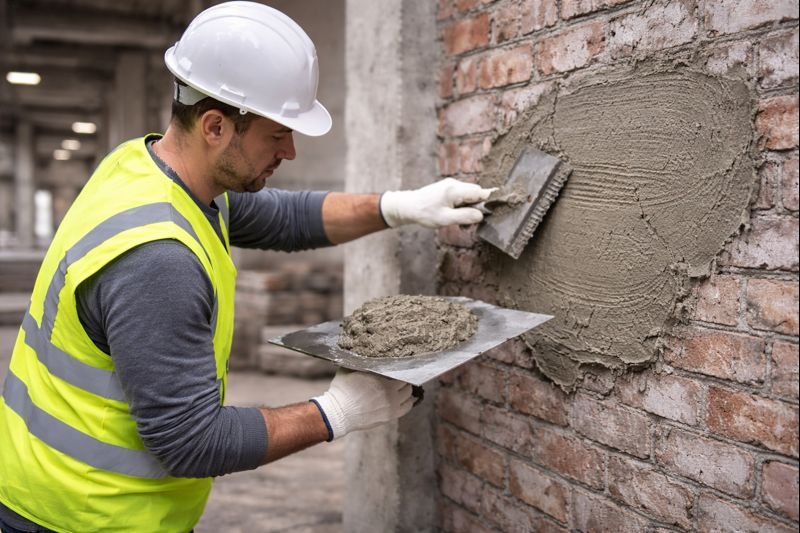
Are you struggling with mortar cracking after drying? Your water-to-cement ratio might be too high. Many contractors add excess water for workability, sacrificing strength and durability in the process.
HPMC (Hydroxypropyl Methylcellulose)1 can typically reduce water requirements in mortar mixes by 5-15%, sometimes more, while maintaining or improving workability. This reduction optimizes the water-cement ratio, resulting in denser, stronger mortar with less shrinkage and cracking.

I've spent years helping mortar manufacturers optimize their formulations. The common misconception I encounter is thinking about HPMC as a "water reducer" when it's actually much more sophisticated. Let me explain why this matters for your projects and how to leverage this technology correctly.
What Quantity of Water Should Be Added for Making Cement Mortar?
Are your mortar mixes inconsistent or prone to failure? Most contractors follow outdated rules of thumb for water addition, creating weak mixes that crack and deteriorate prematurely.
The ideal water quantity for cement mortar depends on its application, but generally ranges from 0.4 to 0.6 water-to-cement ratio by weight. With HPMC, you can maintain excellent workability at the lower end of this range, resulting in stronger, more durable mortar.

Understanding water quantity in mortar is more nuanced than following generic ratios. HPMC works as both a lubricant and suspension agent in your mortar mix. It essentially "wraps" around cement and sand particles, allowing them to slide past each other smoothly, like ball bearings. This mechanism is why you need significantly less "lubricating water" to achieve excellent workability.
This is crucial for professional applications. When we talk about "water reduction," we're referring to "effective water reduction" while maintaining or improving workability. HPMC doesn't literally remove water—it makes water work more efficiently in your mix.
| Consider these key factors when determining water quantity: | Factor | Impact on Water Requirement | HPMC Benefit |
|---|---|---|---|
| Sand texture | Coarser sand needs more water | Reduces water need by 5-10% | |
| Temperature | Higher temperatures increase water demand | Helps retain water in hot conditions | |
| Application | Wall vs. floor applications have different needs | Customizable grades for specific uses | |
| Mix design | Higher cement content needs more water | Optimizes water distribution |
In my experience working with contractors in Saudi Arabia, those who properly optimize their water content with HPMC report up to 30% fewer callbacks for cracking and debonding issues.
How Much Water to Add to Mortar Mix?
Does your mortar lack consistency between batches? Without precise water measurement, you're gambling with your mortar's performance and durability every time you mix.
For standard cement mortar, add water equal to 40-60% of cement weight (by weight). With quality HPMC added at 0.2-0.3%, you can reduce water content by 5-15% while maintaining or improving workability.

Water content is perhaps the most critical factor in mortar performance2, yet it's often the most casually handled on job sites. I've visited countless construction sites where water is added by "feel" rather than measurement, leading to inconsistent results and premature failures.
The science behind proper water addition is straightforward but crucial. When HPMC is incorporated into your mortar formula, it fundamentally changes how water behaves in the mix. The polymer chains in HPMC create a network that holds water molecules, releasing them gradually during the cement hydration process.
This water-retention mechanism provides several advantages:
- Improved workability with less water
- Extended open time for application
- More complete cement hydration
- Reduced bleeding and segregation
- Better adhesion to substrates
Let me break this down with practical numbers. For a typical 1:3 cement-to-sand mortar:
| Without HPMC | With HPMC (0.25%) | Performance Impact |
|---|---|---|
| Water-cement ratio: 0.55-0.65 | Water-cement ratio: 0.45-0.55 | 15-20% strength increase |
| Working time: 30-45 minutes | Working time: 60-90 minutes | Double productivity window |
| Water retention: 75-80% | Water retention: 92-97% | Better curing in hot climates |
| Compressive strength: Standard | Compressive strength: +15-25% | Improved durability |
These aren't just theoretical benefits—I've documented these improvements through laboratory testing and field applications across various climate conditions.
What is the Ideal Mortar Mixing Ratio?
Are you wasting materials and compromising quality with incorrect mortar ratios? Many contractors use one-size-fits-all mixes that fail to meet specific application requirements.
The ideal mortar mixing ratio depends on the application: typically 1:3 to 1:5 (cement:sand) for general use, with water at 40-60% of cement weight. Adding 0.2-0.3% HPMC optimizes water demand while enhancing workability and final properties.

Finding the ideal mortar mixing ratio isn't just about strength—it's about achieving the perfect balance between workability, durability, adhesion, and cost-efficiency. Unfortunately, many contractors and even manufacturers use oversimplified approaches that don't account for specific application needs.
I worked with a major construction company in the UAE that was experiencing high failure rates with their tile adhesive. Their one-size-fits-all approach wasn't accounting for the large-format tiles they had begun using. By adjusting their cement-to-sand ratio from 1:4 to 1:3.5 and incorporating our premium HPMC with proper water reduction, they reduced callbacks by over 70%.
The ideal ratio depends on several factors:
| Application | Recommended Cement:Sand Ratio | HPMC Dosage | Water Reduction |
|---|---|---|---|
| Bricklaying | 1:4 to 1:5 | 0.15-0.2% | 5-10% |
| Rendering | 1:3 to 1:4 | 0.2-0.25% | 10-15% |
| Tile Adhesive | 1:2.5 to 1:3 | 0.25-0.3% | 10-15% |
| Floor Screed | 1:3.5 to 1:4.5 | 0.1-0.2% | 5-10% |
These ratios provide a starting point, but successful contractors fine-tune based on:
- Local sand characteristics (gradation, impurity content)
- Climate conditions (temperature, humidity)
- Substrate properties (porosity, evenness)
- Application requirements (thickness, drying time)
HPMC adds flexibility to these ratios by improving workability even with lower water content. This means you can optimize your mix design for strength and durability without sacrificing ease of application—a win-win that directly impacts your bottom line.
What Happens If I Add Too Much Water to Mortar?
Have you noticed cracks forming in your mortar after it dries? Excessive water is likely the culprit, creating hidden problems that compromise the integrity of your entire project.
Adding too much water to mortar dramatically reduces strength (up to 40% loss for every 10% excess water), increases shrinkage cracking, reduces durability, and creates a porous structure vulnerable to water penetration and freeze-thaw damage.

The consequences of excessive water addition extend far beyond just making mortar "soupy." I've conducted extensive testing in our laboratory that confirms what many contractors learn the hard way: water is a double-edged sword in mortar formulation.
When too much water is added to mortar, several detrimental processes occur simultaneously:
First, the water-to-cement ratio increases beyond the optimal level needed for proper hydration. While cement only needs about 25% of its weight in water for complete hydration, additional water is necessary for workability. However, each incremental increase in water beyond what's needed for proper workability creates additional capillary pores as this excess water evaporates.
These microscopic channels throughout your mortar lead to:
- Reduced compressive strength (potentially by 30-40%)
- Increased permeability to water and aggressive chemicals
- Greater drying shrinkage and subsequent cracking
- Poor freeze-thaw resistance in cold climates
- Reduced bond strength to substrates
- Surface dusting and reduced abrasion resistance
I've analyzed failed mortar installations where contractors added 20-30% excess water, resulting in compressive strengths below 50% of the design specification. One particularly striking case involved a high-rise building in Singapore where over-watered render cost over $200,000 in remediation.
This is precisely why HPMC is so valuable—it allows you to maintain excellent workability with optimized water content. The cellulose structure creates a gel-like network that improves flow while preventing particle segregation, essentially giving you the best of both worlds: easy application and superior strength.
How to Make the Perfect Mortar Mix?
Is your mortar inconsistent, causing project delays and quality issues? Without a systematic approach to mixing, you're relying on luck rather than science for crucial structural elements.
The perfect mortar mix requires precise measurement of materials (not by volume), proper water addition (40-60% of cement weight), incorporation of 0.2-0.3% quality HPMC, adequate mixing time (3-5 minutes), and adjustment based on application and environmental conditions.
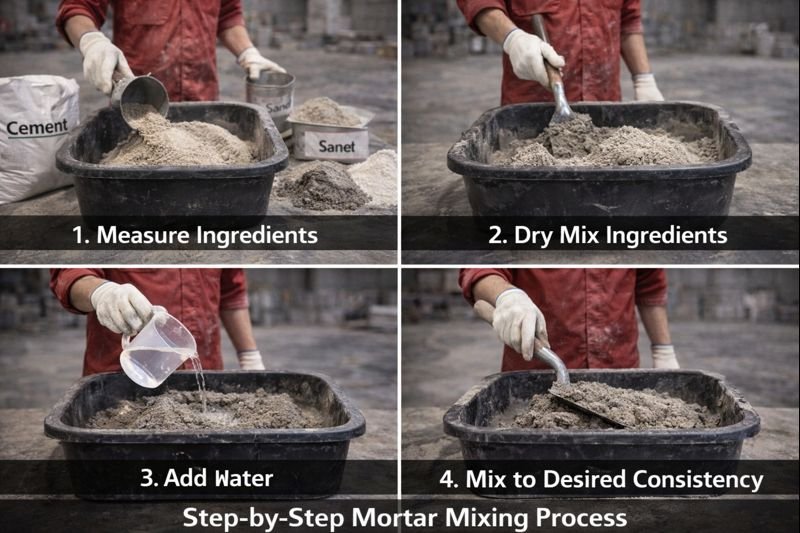
Creating the perfect mortar mix is both science and art. After helping hundreds of contractors optimize their mixing procedures, I've identified the key steps that separate consistently excellent mortar from problematic batches.
The perfect mortar begins with quality control of raw materials. Sand should be well-graded, free from organic matter, and consistently sourced. Cement should be fresh and properly stored. But even with perfect materials, the mixing process determines success or failure.
Here's my proven system for perfect mortar every time:
-
Precise measurement: Weight-based measurement is significantly more accurate than volume-based. Sand moisture content can cause volume variations of up to 25%.
-
Dry mixing: Thoroughly blend cement, sand, and HPMC in dry state for 60-90 seconds to ensure homogeneous distribution.
-
Controlled water addition: Add 75% of the calculated water amount, mix for 2-3 minutes, then add remaining water as needed to achieve target consistency.
-
Proper HPMC incorporation: Our kehao HPMC should be pre-dispersed in dry mix or mixed with a small portion of water before adding to prevent lumping.
-
Adequate mixing time: Under-mixing is common but detrimental. A minimum of 3-5 minutes with mechanical mixing is necessary for HPMC to fully activate.
-
Consistency testing: Use simple field tests (slump, flow table) to verify consistency between batches.
-
Rest period: Allow mixed mortar to rest for 3-5 minutes before final adjustment and application to let HPMC fully hydrate.
I've implemented this system with major contractors in Pakistan and Saudi Arabia, resulting in up to 40% fewer mixing-related issues and significant reductions in material waste. One client reported saving over $30,000 annually simply by implementing proper mixing protocols with our HPMC.
The perfect mortar mix isn't just about following a recipe—it's about understanding how each component interacts and how to balance them for optimal performance. With quality HPMC from kehao, you gain more flexibility and forgiveness in your mix while achieving superior end results.
Conclusion
HPMC isn't a water reducer—it's an optimizer that lets your mortar achieve maximum performance with minimum water. By reducing water content 5-15% while improving workability, you'll create stronger, crack-resistant mortar that lasts longer and performs better.
Contact ada@xhhpmc.com for custom formulations and more information.