Struggling with runny shampoo formulations that disappoint customers and hurt sales? The right thickener makes all the difference between professional-grade consistency and amateur results that damage your brand reputation.
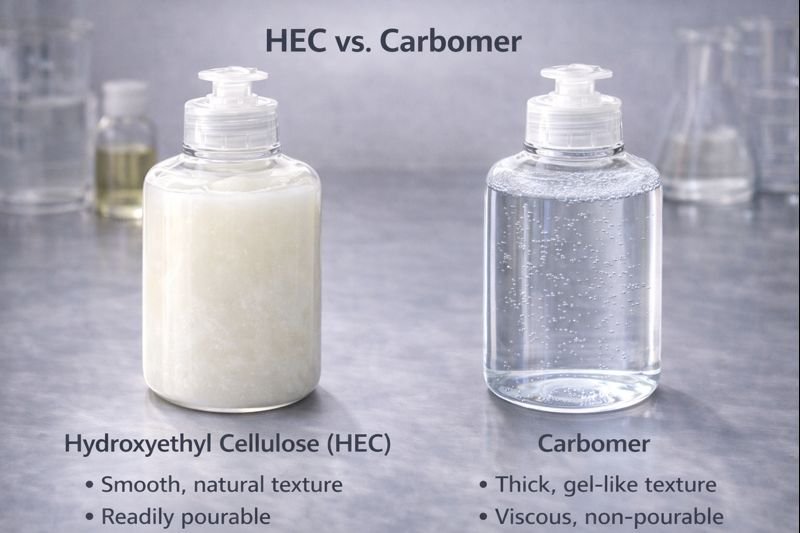
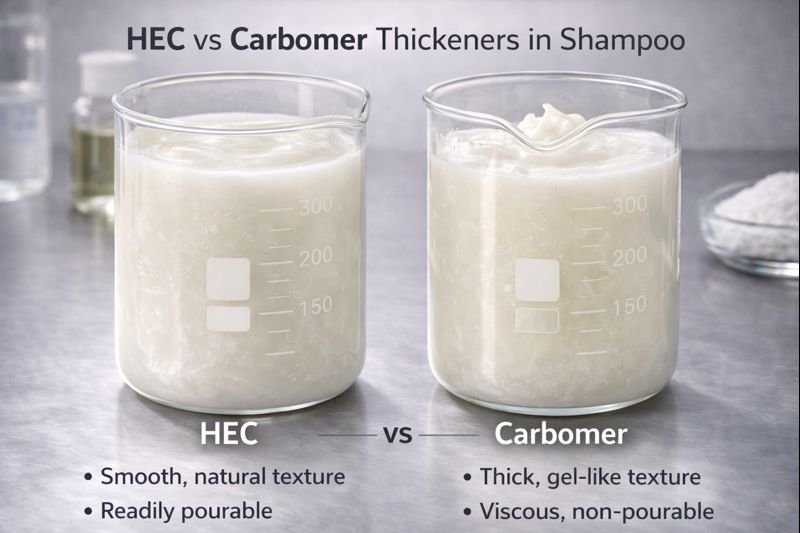
For shampoo formulations, hydroxyethyl cellulose (HEC)1 generally outperforms carbomer2 as it works across wider pH ranges (3-10), resists electrolyte interference from hard water and surfactants, and offers better shear-thinning properties for smooth dispensing at approximately 30% lower cost.
I remember when one of our clients lost an entire production batch because they chose the wrong thickener. Their story highlights why this decision matters so much for your formula's stability and performance. Let's look at what makes these thickeners different and how to pick the right one for your specific needs.
What is the best thickener for shampoo?
Are you wasting money on expensive thickeners when cheaper alternatives might work better? Many formulators overlook critical compatibility factors that lead to product failures and customer complaints.
The best shampoo thickener depends on your formulation needs. HEC (hydroxyethyl cellulose) works excellently across wide pH ranges (3-10) and with most ingredients. Carbomer creates crystal-clear gels but requires neutralization (pH 6+) and can be destabilized by electrolytes and certain surfactants.
Finding the right thickener isn't just about viscosity—it's about creating the perfect user experience. In my 15+ years working with personal care manufacturers, I've seen how thickener selection impacts everything from production efficiency to customer satisfaction.
Key Selection Factors for Shampoo Thickeners
When selecting a thickener for your shampoo, several factors must be considered:
| Factor | HEC | Carbomer |
|---|---|---|
| pH Range | Wide (pH 3-10) | Narrow (pH 6+) |
| Electrolyte Tolerance | High | Low |
| Clarity | Good | Excellent |
| Shear Properties | Excellent flow recovery | Firmer gel structure |
| Cost | Lower (≈30% less) | Higher |
The pH dependency is perhaps the most critical factor. HEC maintains its thickening effect across acidic to basic conditions, while carbomer requires neutralization at pH 6 or higher to activate. This gives HEC-based formulations much more flexibility, especially for specialized shampoos that need specific pH levels for performance or scalp health.
I once worked with a manufacturer who needed to formulate an anti-dandruff shampoo with zinc pyrithione—an active that works best at lower pH. Their carbomer-based formula completely failed because the thickener couldn't activate properly in the acidic environment. Switching to HEC solved their problem immediately and saved their product launch.
What is the difference between HEC and Carbomer?
Have you noticed how some shampoos maintain perfect thickness even after sitting on the shelf for months, while others separate or thin out? The chemistry behind your thickener choice determines long-term stability.
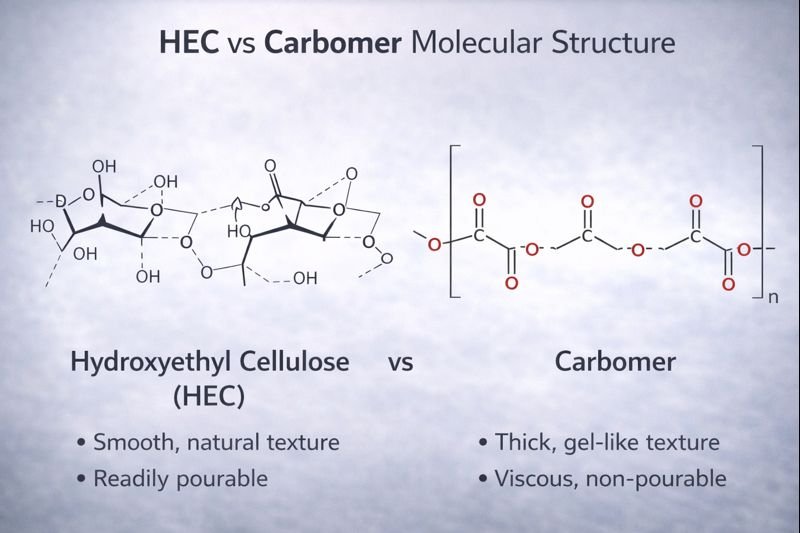
HEC (hydroxyethyl cellulose) is a nonionic cellulose derivative that thickens through polymer entanglement, while carbomer is an acrylic acid polymer that thickens by forming a gel network when neutralized. HEC works across pH 3-10 without neutralization, whereas carbomer requires pH adjustment to activate.
My team recently helped a client troubleshoot a formula that kept failing stability tests. The problem wasn't immediately obvious until we examined their water source.
Chemical Structure and Mechanism of Action
The fundamental difference between these thickeners lies in their molecular structure and thickening mechanism. HEC is derived from cellulose, a natural polymer, and its thickening power comes from the physical entanglement of its long polymer chains in water. When added to a formulation, HEC hydrates and creates a three-dimensional network that increases viscosity.
Carbomer, on the other hand, consists of cross-linked polyacrylic acid. In its acidic form, carbomer molecules remain tightly coiled. The magic happens when you neutralize it with a base (like triethanolamine or sodium hydroxide)—the polymer uncoils and expands dramatically, creating a clear gel network.
This difference explains why carbomer is highly pH-dependent while HEC is not. I've seen formulators struggle with carbomer when they try to incorporate acidic active ingredients or when they don't add enough neutralizer. The result is often unpredictable viscosity or even complete formulation failure.
Another critical difference is their ionic nature. HEC is nonionic, meaning it's not affected by charged particles in your formulation. Carbomer is anionic (negatively charged) when activated, making it susceptible to interference from cations like calcium, magnesium (found in hard water), or positively charged ingredients.
Can carbomer be used as a thickener?
Does your premium shampoo formula need that crystal-clear appearance that signals quality to consumers? Many brands sacrifice formulation stability for appearance without understanding the tradeoffs.
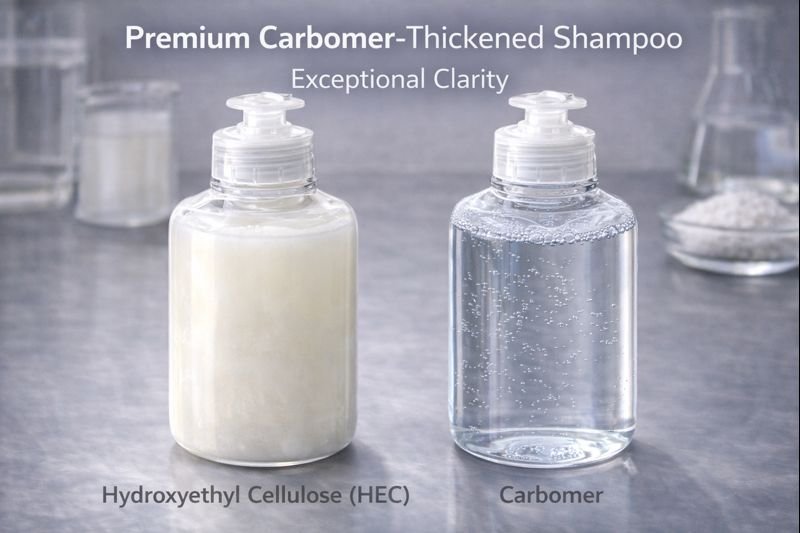
Yes, carbomer is an excellent thickener for shampoos requiring exceptional clarity and a luxurious gel-like consistency. However, it performs best only in neutral to alkaline conditions (pH 6+), and its effectiveness decreases significantly in formulations with high electrolyte content or certain surfactants like SLES.
Learning how to work with carbomer's limitations can help you leverage its strengths. During my visits to manufacturing facilities across Asia, I've noticed recurring issues with carbomer implementation.
Optimizing Carbomer Performance in Shampoos
Despite its limitations, carbomer remains a popular choice for premium shampoo formulations where exceptional clarity and luxurious texture are paramount. To successfully incorporate carbomer as a thickener, formulators must carefully manage several variables.
The neutralization process is critical—carbomer typically requires a pH between 6 and 8 for optimal performance. The choice of neutralizing agent also matters. While sodium hydroxide is cost-effective, triethanolamine (TEA) often provides better stability and a more pleasant skin feel. I recommend starting with lower carbomer concentrations (0.2-0.4%) and gradually adjusting upward to achieve desired viscosity.
Water quality significantly impacts carbomer performance. During a consultation with a client in the Middle East, we discovered their inconsistent batch results stemmed from varying mineral content in their water supply. The high calcium content was destabilizing the carbomer network. Implementing a water purification system resolved the issue and improved batch-to-batch consistency.
Another consideration is the order of addition. For best results, pre-disperse carbomer in water before adding surfactants, and neutralize last. This prevents "fish-eyes" (undispersed clumps) and ensures optimal thickening efficiency.
| Carbomer Grade | Recommended Use | Viscosity Profile |
|---|---|---|
| Carbopol 940 | Premium clear gels | Highest viscosity |
| Carbopol 980 | General purpose | High viscosity, good clarity |
| Carbopol Ultrez 10 | Easy dispersing | Medium viscosity, quick hydration |
| Carbopol Aqua SF-1 | Surfactant systems | Pre-neutralized, surfactant-friendly |
Can xanthan gum3 be used to thicken shampoo?
Are you looking for natural thickening alternatives that can withstand challenging formulation conditions? Xanthan gum offers unique properties that might solve problems that synthetic options can't handle.
Yes, xanthan gum can effectively thicken shampoo formulations. This natural polysaccharide works across a wide pH range, provides excellent suspension properties, and resists breakdown in high-electrolyte environments. However, it typically creates a less clear solution than carbomer and can impart a slightly slimy texture at higher concentrations.
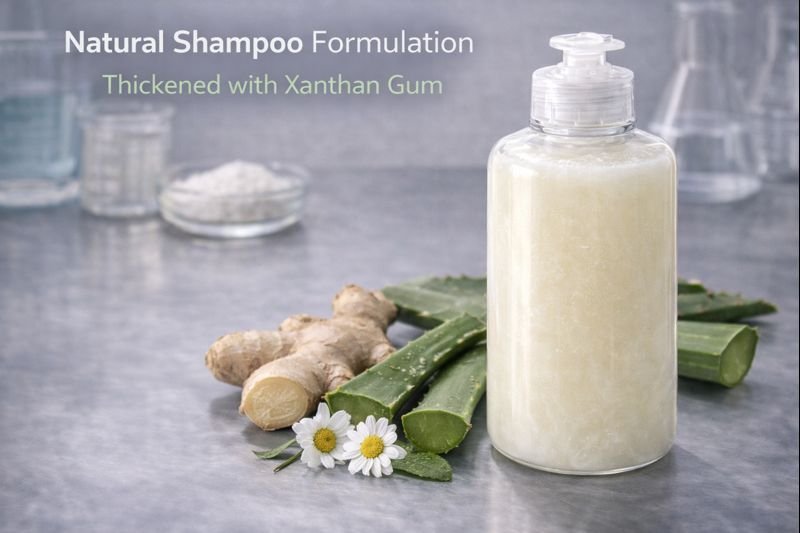
While testing formulations for natural product lines, I've found xanthan gum offers unique benefits that neither HEC nor carbomer can match.
Xanthan Gum as an Alternative Thickener
Xanthan gum has gained popularity as a thickening agent in natural and "clean" formulations. This bacterial polysaccharide brings several advantages to shampoo formulations that are worth considering alongside HEC and carbomer.
One of xanthan gum's most valuable properties is its exceptional suspension ability. Unlike HEC and carbomer, it forms a pseudoplastic network that can hold particulates like exfoliants, botanical extracts, or anti-dandruff actives in perfect suspension over long periods. This makes it particularly useful for 2-in-1 formulations or specialty shampoos with suspended active ingredients.
Xanthan also exhibits remarkable stability across a wide pH range (pH 3-12) and in the presence of electrolytes, outperforming both HEC and carbomer in highly mineralized water or formulations with high salt content. During stability testing for a client's salt-based scalp therapy shampoo, xanthan was the only thickener that maintained consistent viscosity over the 3-month accelerated aging period.
The main drawbacks of xanthan gum include its natural color (slightly off-white to tan), which can affect the clarity of transparent formulations, and its characteristic "slimy" texture when used at higher concentrations. Most formulators find the sweet spot between 0.3-0.7%, where thickness is achieved without excessive sliminess.
| Property | Xanthan Gum | HEC | Carbomer |
|---|---|---|---|
| Source | Natural (fermentation) | Semi-synthetic | Synthetic |
| pH Stability | Excellent (3-12) | Very Good (3-10) | Limited (6+) |
| Electrolyte Tolerance | Excellent | Good | Poor |
| Suspension Ability | Excellent | Moderate | Good |
| Clarity | Moderate | Good | Excellent |
| Texture | Can be slimy | Smooth | Gel-like |
Conclusion
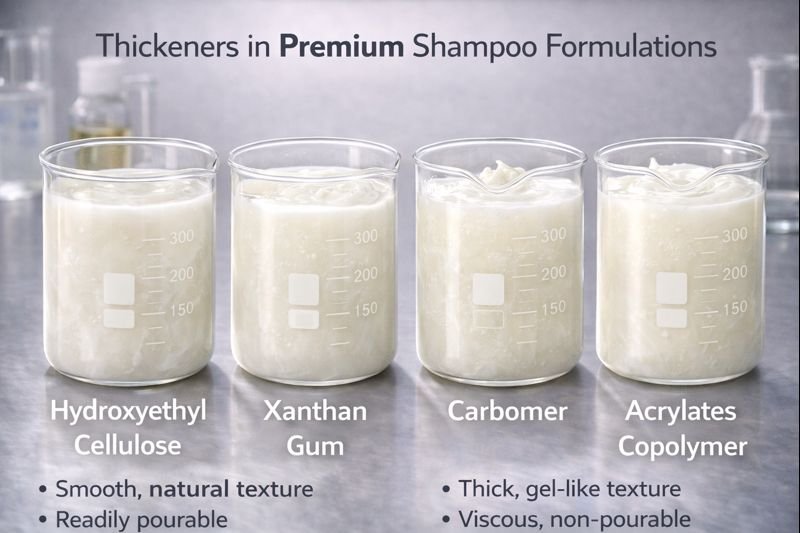
For most shampoo formulations, HEC offers the best balance of versatility, stability, and cost-effectiveness. Carbomer excels where crystal clarity is essential, while xanthan gum shines in natural formulations needing suspension properties. Choose your thickener based on your specific pH requirements, electrolyte levels, and desired feel.
FAQ
Can I mix different thickeners in one formulation?
Yes, combining thickeners like HEC and carbomer can leverage the advantages of both while minimizing limitations. Start with small percentages of each and adjust as needed.
How does salt affect these thickeners?
Salt (sodium chloride) can boost viscosity in surfactant systems but may destabilize carbomer. HEC and xanthan gum show better salt tolerance.
Which thickener is best for sulfate-free formulations?
HEC generally performs better in sulfate-free systems, as carbomer can interact negatively with some alternative surfactants.
How can I improve the feel of HEC-thickened shampoos?
Adding small amounts of conditioning polymers or silicones can enhance the feel of HEC-thickened formulations without compromising stability.
Are these thickeners biodegradable?
HEC and xanthan gum are biodegradable. Carbomer is not readily biodegradable but can be included in "clean" formulations depending on certification standards.
-
Explore how HEC enhances shampoo formulations with its superior thickening properties and cost-effectiveness. ↩
-
Learn about carbomer's role in creating crystal-clear gels and its limitations in shampoo formulations. ↩
-
Explore how xanthan gum can enhance natural shampoo formulations with its unique properties. ↩