Struggling with inconsistent mortar performance and wondering which cellulose ether will solve your construction headaches? Many contractors face this exact problem, wasting time and money on unsuitable products.
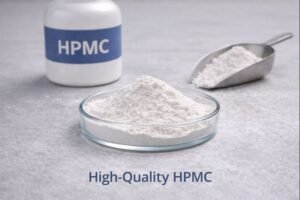
HPMC (Hydroxypropyl Methylcellulose)1 outperforms other cellulose ethers in construction due to its superior water retention (>90%), balanced rheology, and versatility across applications. It offers better workability than MC, more stability with cement than CMC, and better price-performance ratio than HEC or MHEC.
After 15 years supplying cellulose ethers to major construction projects across Asia and the Middle East, I've seen firsthand how choosing the right additive can make or break a project. Let me share what I've learned about these critical yet often misunderstood construction chemicals.
What is Hydroxypropyl Methylcellulose Used For in Construction?
Contractors frequently ask me what makes HPMC so essential in modern construction. The answer lies in its unique problem-solving abilities that other additives simply can't match.
HPMC functions as a water retention agent, thickener, binder, and rheology modifier in construction materials. It's primarily used in tile adhesives2, renders, self-leveling compounds3, gypsum plasters4, and EIFS systems5 to improve workability, extend open time6, and enhance adhesion.
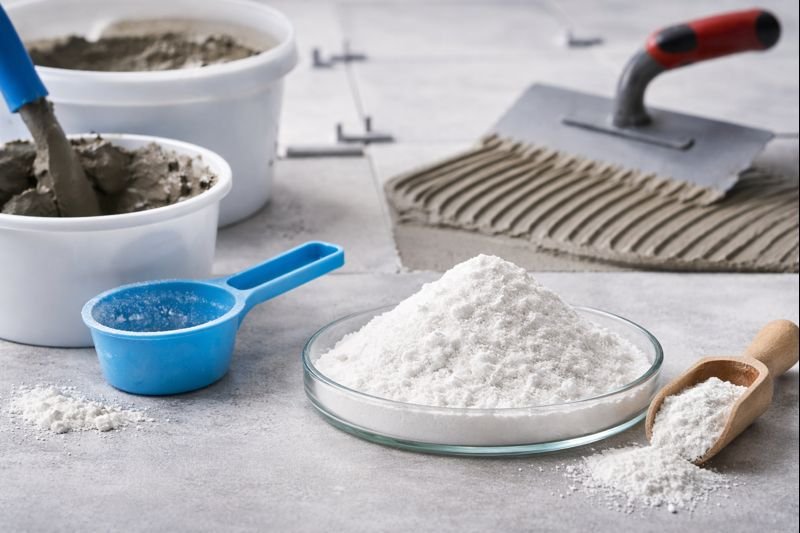
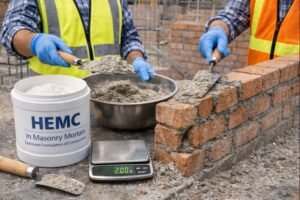
Diving deeper into HPMC's applications reveals why it's become indispensable in modern construction chemistry. Unlike basic additives, HPMC does more than just one job. When added to cement-based materials at typically 0.2-0.5% concentration, it transforms ordinary mortars into high-performance systems.
In tile adhesives, HPMC with viscosity ranges of 15,000-100,000 mPa·s creates the perfect balance of slip resistance and extended open time. For renders and plasters, grades with 4,000-30,000 mPa·s viscosity improve workability while preventing sagging. Self-leveling compounds benefit from lower viscosity HPMC (3,000-10,000 mPa·s) that enhances flow characteristics without sacrificing water retention.
The methoxyl content (19-30%) and hydroxypropyl content (4-12%) can be tailored to specific applications. For instance, higher methoxyl substitution improves water retention, while higher hydroxypropyl content enhances surface activity and compatibility with other additives. This customization capability makes HPMC uniquely versatile compared to other cellulose ethers.
| Application | Recommended HPMC Viscosity | Key Benefit |
|---|---|---|
| Tile Adhesives | 15,000-100,000 mPa·s | Extended open time |
| Renders/Plasters | 4,000-30,000 mPa·s | Anti-sagging |
| Self-leveling | 3,000-10,000 mPa·s | Improved flow |
| EIFS | 15,000-50,000 mPa·s | Workability retention |
What is the Difference Between CMC and HPMC?
When customers ask me why CMC is cheaper, I have to explain that sometimes saving money upfront leads to costly failures later. The chemistry makes all the difference.
CMC (Carboxymethyl Cellulose)7 differs from HPMC primarily in its ionic nature and calcium sensitivity. While CMC offers lower costs and higher viscosity at equal dosages, it precipitates in cement due to calcium ion interaction. HPMC, being non-ionic, remains stable in all alkaline building materials and provides superior water retention.
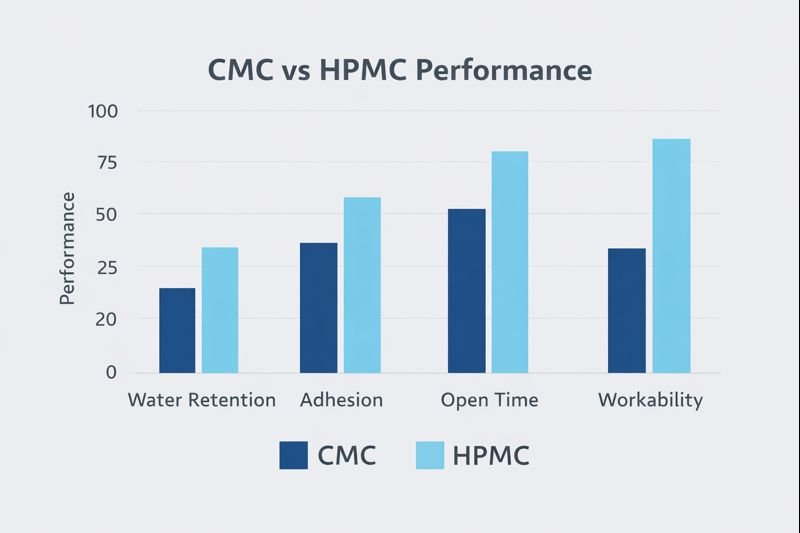
Analyzing the fundamental chemical differences reveals why experienced builders prefer HPMC despite its higher cost. CMC contains carboxyl groups that react with calcium ions in cement, creating insoluble precipitates that severely compromise performance. This reaction essentially "deactivates" the CMC, making it unsuitable for high-quality cement-based formulations.
I once supplied both CMC and HPMC to a customer in Saudi Arabia for comparative testing. Despite CMC being 30% cheaper, they reported that mortars made with CMC showed dramatic performance degradation within 30 minutes of mixing, particularly in water retention (dropping below 70%). The same mix with HPMC maintained water retention above 90% for over 2 hours.
Water retention is critical because it prevents rapid water loss to porous substrates and premature drying, especially in hot climates. HPMC's superior performance in this regard directly correlates to better hydration of cement particles and ultimately stronger bond strength. Quantitatively, HPMC typically provides water retention values of 90-98% compared to CMC's 60-75% in cement systems.
| Property | CMC | HPMC |
|---|---|---|
| Chemical Nature | Ionic (anionic) | Non-ionic |
| Cement Compatibility | Poor (precipitates) | Excellent |
| Water Retention | 60-75% | 90-98% |
| Cost | Lower | Higher |
| Temperature Stability | Moderate | Good |
| Biological Resistance | Poor | Good |
What is the Difference Between Methylcellulose and HPMC?
In my factory tours, clients often confuse MC and HPMC, assuming they're interchangeable. Their chemical structures look similar, but their performance tells a different story.
Methylcellulose (MC) differs from HPMC by lacking hydroxypropyl groups, which impacts solubility and thermal gelation. MC has lower surface activity, poorer cement compatibility, and forms stronger thermal gels at lower temperatures (50-55°C) compared to HPMC (65-70°C), making HPMC more versatile across varying application temperatures.
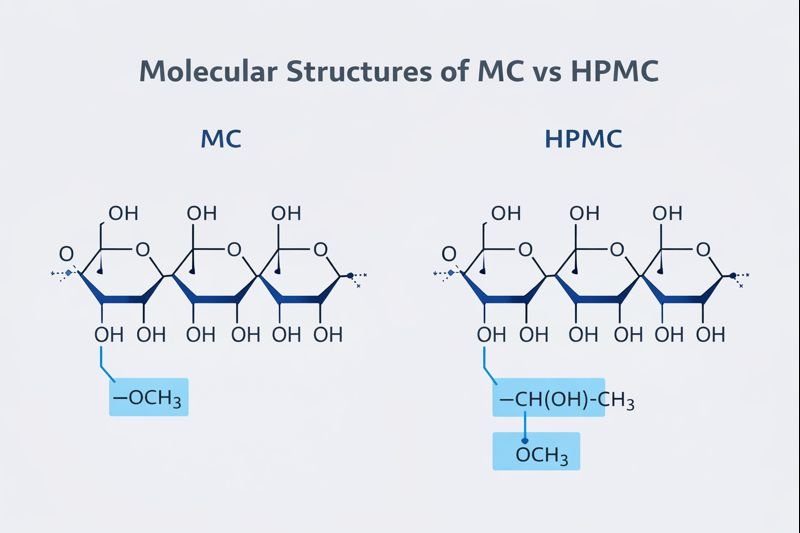
Digging into the molecular differences reveals practical implications that affect jobsite performance. The hydroxypropyl groups in HPMC create steric hindrance and improve compatibility with hydrophobic materials like polymers and cement additives. This makes HPMC significantly more effective in complex formulations like polymer-modified mortars and EIFS systems.
Temperature sensitivity represents another critical distinction. When ambient temperatures rise, both MC and HPMC undergo thermal gelation, but at different thresholds. MC's lower gelation temperature (50-55°C) can cause premature stiffening in hot weather applications, while HPMC's higher threshold (65-70°C) provides a wider working temperature range.
I've witnessed this difference firsthand during summer projects in the UAE. Customers using MC-based mortars reported application difficulties when surface temperatures exceeded 45°C, while HPMC formulations remained workable under the same conditions. For construction professionals working in variable climates, this temperature stability translates directly to reduced waste and more consistent application.
The surface activity differential also impacts air entrainment and workability. HPMC's enhanced surface activity introduces controlled microporosity that improves workability and reduces density without compromising strength. MC provides less pronounced air entrainment, resulting in denser but potentially more difficult-to-work materials.
| Property | MC | HPMC |
|---|---|---|
| Thermal Gelation | 50-55°C | 65-70°C |
| Surface Activity | Lower | Higher |
| Polymer Compatibility | Moderate | Excellent |
| Working Temperature Range | Narrower | Wider |
| Cost | Lower | Higher |
| Application Versatility | Limited | Extensive |
What is the Difference Between HPMC and MHEC?
A project manager once asked me why some German products use MHEC instead of HPMC. The answer lies in specific performance characteristics that matter in certain applications.
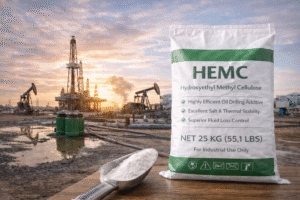
MHEC (Hydroxyethyl Methylcellulose)8 differs from HPMC in having hydroxyethyl instead of hydroxypropyl groups, resulting in higher biostability and better high-temperature viscosity retention. MHEC demonstrates superior performance in gypsum-based systems but costs approximately 30% more than HPMC and dissolves more slowly in cold water.
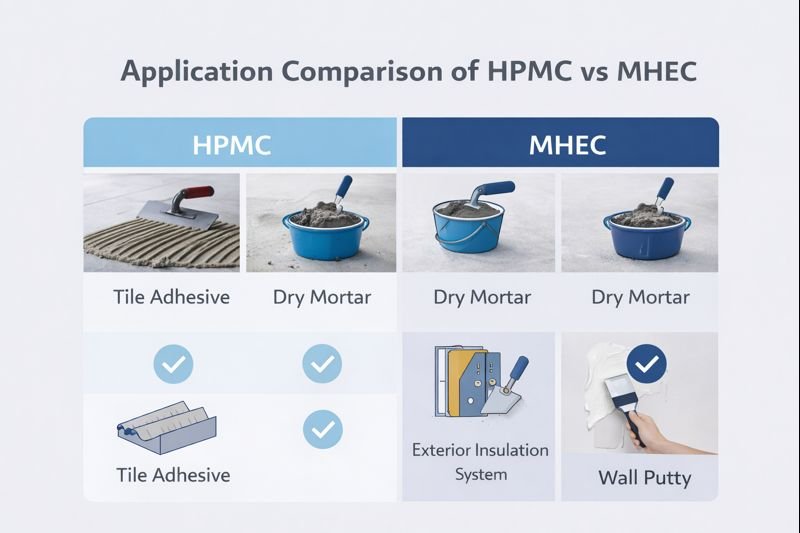
Exploring the performance differences requires understanding how molecular structure influences practical properties. The hydroxyethyl groups in MHEC create different hydrogen bonding patterns compared to HPMC's hydroxypropyl groups. This subtle change impacts critical application properties like dissolution kinetics, rheology, and thermal stability.
In temperature stability tests I've conducted, MHEC retained approximately 85% of its original viscosity at 60°C, while comparable HPMC grades maintained only about 70%. This superior high-temperature stability makes MHEC particularly valuable for applications in hot climates or where extended working time at elevated temperatures is required.
Gypsum compatibility represents another key difference. MHEC typically demonstrates better compatibility with gypsum systems due to its specific interaction with calcium sulfate particles. In comparative testing with a major gypsum manufacturer, MHEC-modified formulations showed approximately 15% better water retention and 20% improved sag resistance compared to identical HPMC formulations.
However, these performance advantages come at a cost. MHEC's more complex manufacturing process results in prices approximately 25-35% higher than comparable HPMC grades. Additionally, MHEC typically requires longer dissolution times, especially in cold water, which can impact production efficiency.
Some manufacturers overcome these limitations by creating specialized blends of HPMC and MHEC to optimize performance-cost ratios for specific applications. I've helped several customers develop such hybrid solutions, particularly for exterior insulation finishing systems (EIFS) where balanced performance across multiple parameters is critical.
| Property | HPMC | MHEC |
|---|---|---|
| High Temperature Stability | Good | Better |
| Dissolution Speed | Faster | Slower |
| Gypsum Compatibility | Good | Excellent |
| Cost | Lower | Higher (+30%) |
| Enzyme Resistance | Good | Better |
| Manufacturing Complexity | Lower | Higher |
Conclusion
HPMC stands out among cellulose ethers for construction due to its balanced performance profile, offering superior water retention and versatility. While CMC, MC, and MHEC each have specific advantages, HPMC provides the most comprehensive solution for modern construction needs.
FAQ
Can CMC be used instead of HPMC to reduce costs?
CMC can replace HPMC only in non-cement applications like wallpaper adhesives. In cement-based materials, CMC precipitates due to calcium ions, causing performance failure.
How do I choose between HPMC viscosity grades?
Select viscosity based on application: 3,000-10,000 mPa·s for self-leveling compounds3, 15,000-30,000 mPa·s for standard mortars, and 30,000-100,000 mPa·s for heavy-bodied adhesives and anti-sag applications.
Does higher viscosity HPMC always mean better water retention?
Not necessarily. Water retention correlates more with methoxyl content and molecular substitution pattern than with viscosity alone. Always check manufacturer specifications for water retention values.
Is cold-water-soluble HPMC worth the premium price?
For large industrial operations, cold-water-soluble grades justify their 15-20% premium by eliminating hot water preparation and reducing mixing time by up to 75%. For smaller operations, standard grades may be more economical.
How does HPMC affect cement hydration?
HPMC temporarily delays initial cement hydration but improves overall hydration by maintaining optimal water content throughout curing. This results in higher ultimate strength despite potential early-stage retardation.
-
Explore how HPMC enhances construction materials with superior water retention and versatility. ↩
-
Find expert tips on optimizing tile adhesive performance for better results. ↩
-
Understand the science behind self-leveling compounds and their application benefits. ↩ ↩
-
Explore the benefits of gypsum plasters for efficient and effective construction. ↩
-
Learn about the advantages of Exterior Insulation and Finish Systems in modern building. ↩
-
Understand the significance of open time for effective application of construction materials. ↩
-
Get insights into the differences between CMC and HPMC for informed material choices. ↩
-
Explore how MHEC enhances performance in specific construction scenarios. ↩