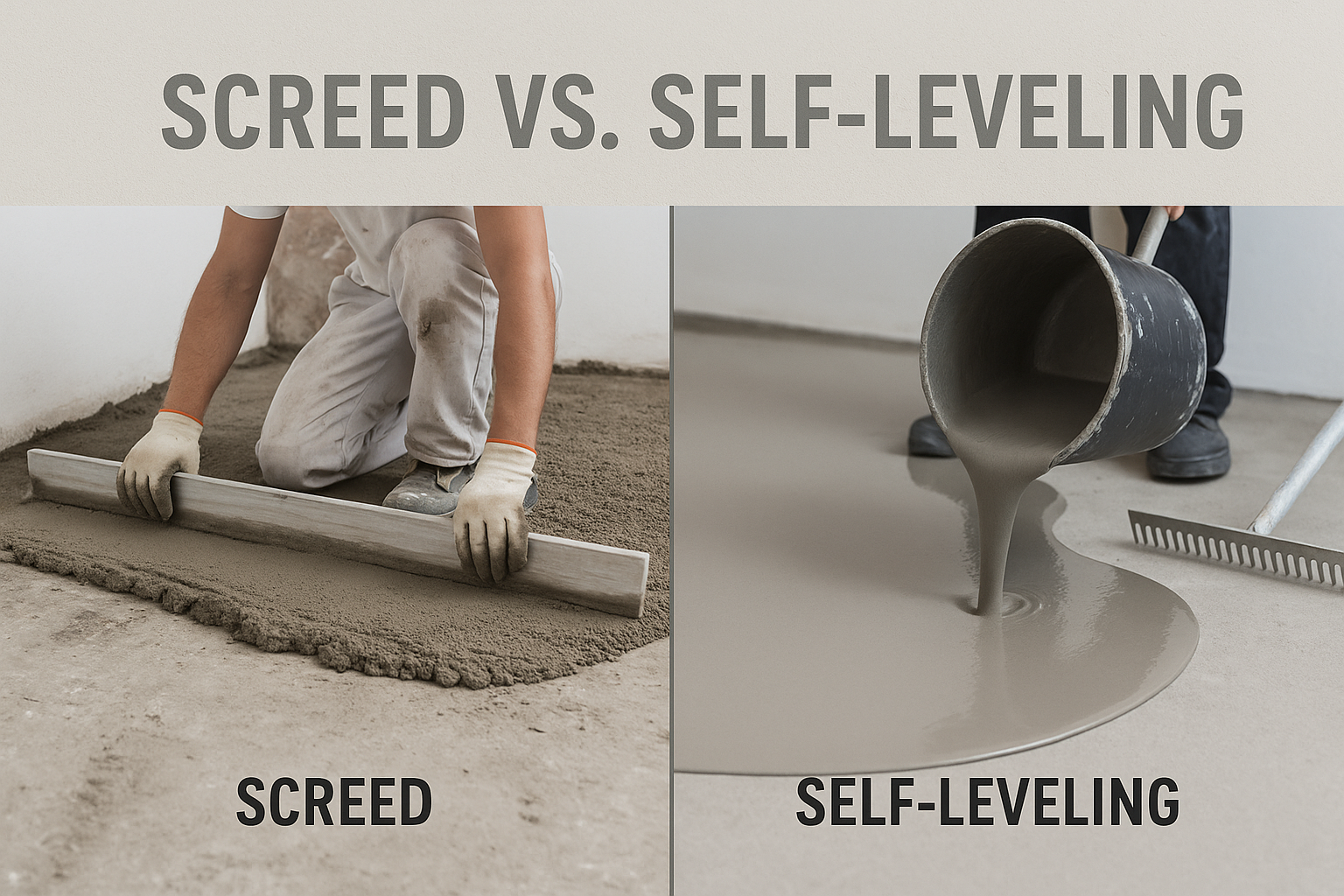
Are you struggling with uneven floors and wondering which solution is best? Many of our clients face this problem when preparing substrates for final flooring installation, often choosing the wrong option and wasting both time and money.
The key difference between screed and self-leveling compound1 lies in their application and properties. Screed is a traditional, thicker mixture (typically 50-75mm) requiring manual leveling, while self-leveling compounds are fluid materials (2-10mm) that automatically create a smooth, level surface with minimal effort.

As a manufacturer with over 15 years in the construction chemicals2 industry, I've seen countless flooring projects succeed or fail based on this single choice. The right substrate preparation can determine the longevity and appearance of your final floor covering. Let me break down these options so you can make an informed decision.
What's the Difference Between Cement Screed and Self-Leveling Compound?
Your project is at risk of delays and budget overruns if you choose incorrectly. Many contractors face rework and material waste when they don't understand the fundamental differences between these floor preparation methods.
Cement screed and self-leveling compound1s differ primarily in application thickness, drying time, and labor requirements. Cement screed suits deeper applications (50-75mm) with longer drying times (7+ days), while self-leveling compounds are thin-layer (2-10mm), quick-drying (24-48 hours) solutions requiring less manual labor.

When selecting between these options, you need to consider several factors beyond just the immediate application. The substrate condition, intended final flooring, time constraints, and budget all play crucial roles in making the right choice. I've worked with clients across Saudi Arabia, UAE, and other markets who initially focused solely on material costs, only to discover that labor expenses and project timelines were significantly impacted by their choice.
What is Screed?
Pain points emerge when contractors underestimate the complexity of traditional screeding. I've seen projects delayed by weeks due to improper installation and extended drying times that weren't factored into the schedule.
Screed is a cement-based mixture of cement, fine aggregates, and water applied at thicknesses between 50-75mm to create a smooth, flat surface for subsequent flooring installation. Traditional screed requires manual leveling, careful curing, and typically 7-28 days drying time depending on thickness.

Traditional cement screed has been used for decades in construction and remains popular despite newer alternatives. This traditional approach involves mixing cement, fine aggregates (usually sand), and water to create a semi-dry consistency similar to earth-moist concrete. The mixture is then spread across the substrate, manually leveled, and compacted.
There are several types of screed worth considering:
| Screed Type | Composition | Typical Thickness | Drying Time | Best For |
|---|---|---|---|---|
| Traditional | Cement & sand | 50-75mm | 7-28 days | General purpose |
| Fast-drying | Modified cement | 50-75mm | 24-72 hours | Time-sensitive projects |
| Floating | Traditional over insulation | 65mm+ | 7-28 days | Thermal/acoustic insulation |
| Bonded | Applied directly to concrete | 25-40mm | 7-14 days | Thin applications |
| Fiber-reinforced | Contains PP/steel fibers | 50-75mm | 7-28 days | High traffic areas |
The installation process requires skilled laborers who can achieve the correct levels using screeding rails and a straightedge. This manual process creates variation in quality depending on the workmanship, which is why I always recommend working with experienced contractors when using traditional screed methods.
Advantages of Screed:
Do you worry about handling heavy traffic areas or need substantial floor height adjustments? Many clients struggle with these requirements while staying within budget constraints.
Traditional screed offers key advantages including higher thickness capability (50-75mm+), lower material cost per square meter, excellent compressive strength3 for heavy loads, ability to incorporate underfloor heating systems, and better suitability for creating falls and drainage slopes.

Traditional cement screed excels in certain applications where its properties make it the ideal choice despite its longer installation and drying time4. From my experience supplying HPMC for screed products across the Middle East and Asia, I've observed several situations where screed consistently outperforms newer alternatives.
Cost efficiency is a major factor in large commercial projects. The raw materials for traditional screed are significantly less expensive than specialized self-leveling compounds, especially when covering large areas. For a 500m² warehouse floor I worked on in Dubai last year, the client saved approximately 30% on material costs by choosing traditional screed over self-leveling alternatives.
Traditional screed also provides superior load-bearing capacity when properly installed. This makes it ideal for industrial settings, workshops, and areas where heavy machinery will operate. The compressive strength typically ranges from 20-30 N/mm², depending on the mix design and additives used.
When creating drainage slopes or falls, traditional screed offers better workability for forming gradients. This is particularly valuable in wet areas, outdoor spaces, or industrial settings where proper drainage is essential. The semi-dry consistency allows for precise formation of slopes that remain stable during curing.
What is Self-Leveling Compound?
Are tight project deadlines keeping you up at night? Many contractors face penalties for delays when traditional screeding takes too long to install and dry before final floor coverings can be applied.
Self-leveling compound is a polymer-modified cement-based product that flows easily when poured and automatically levels itself to create a smooth, flat surface at thicknesses of 2-10mm. These high-flow compounds require minimal labor, dry within 24-48 hours, and provide exceptional smoothness.

Self-leveling compounds represent the more modern approach to floor substrate preparation. These materials began gaining popularity in the 1980s but have seen significant technological advancements in recent years. The formulation typically includes Portland cement, specialized aggregates, polymers, and various additives including our company's hydroxypropyl methylcellulose (HPMC) and redispersible polymer powders that enhance flow characteristics and adhesion properties.
The application process differs dramatically from traditional screed. Self-leveling compounds are mixed with precise water ratios to create a fluid consistency that can be poured or pumped onto the substrate. The material's flow properties allow it to seek its own level with minimal assistance, typically requiring only light spreading with a gauge rake or smoothing tool.
Modern self-leveling compounds include specialized variants for different scenarios:
| Type | Main Additives | Typical Thickness | Drying Time | Best For |
|---|---|---|---|---|
| Standard | HPMC & polymer | 2-10mm | 24-48 hours | Residential/light commercial |
| Fiber-reinforced | PP fibers + HPMC | 3-15mm | 24-48 hours | Areas with substrate movement |
| Rapid-setting | Special cements | 2-10mm | 2-6 hours | Ultra-fast turnaround |
| Deep-fill | Coarser aggregates | 5-50mm | 48-72 hours | Deeper applications |
| Moisture-resistant | Hydrophobic additives | 2-10mm | 24-48 hours | Damp environments |
The chemical additives in these formulations are critical to performance. Our factory produces specialized HPMC grades specifically designed for self-leveling compounds, providing the crucial water retention and workability these systems require.
Advantages of Self-Leveling Compound:
Are you frustrated with uneven floors5 that show through your final floor coverings? Many installers struggle to achieve the perfect smoothness required for modern thin flooring materials like vinyl and laminate.
Self-leveling compounds offer superior flatness (±2mm over 2m vs ±5mm for screed), faster installation and drying (24-48 hours vs 7+ days), reduced labor costs, exceptional smoothness for thin floor coverings, and compatibility with various subfloor types including concrete, wood, and existing tile.

The exceptional flatness achieved by self-leveling compounds is perhaps their most significant advantage. Modern flooring materials like luxury vinyl tile (LVT), laminate, and thin ceramic tiles demand exceptionally flat substrates to prevent visual defects and premature failure. Self-leveling compounds routinely achieve tolerances of ±2mm over 2m compared to traditional screed's typical ±5mm over 2m.
Time efficiency is another crucial benefit, especially in commercial renovation projects where business downtime must be minimized. I recently consulted on a hotel renovation in Riyadh where the client needed to renovate guest room floors with minimal disruption. By using rapid-setting self-leveling compound1s containing our specialized HPMC grade, they were able to apply the compound in the morning and install carpet tiles the next day—a timeline impossible with traditional screed.
Labor costs and skill requirements also favor self-leveling products. While traditional screeding requires experienced tradespeople for proper installation, self-leveling compounds can be successfully installed with less specialized training. The reduced labor intensity translates to cost savings that can partially offset the higher material costs.
The superior smoothness of self-leveling compounds is particularly important when installing sensitive flooring types. Thin vinyl, laminate, and engineered wood products will telegraph any substrate imperfections, making the flawless finish of self-leveling compounds ideal for these applications.
Differences Between Screed and Self-Leveling Compound:
Are you confused about which option best suits your specific project requirements? This is the most common question I receive from clients, and making the wrong choice can lead to wasted materials, additional costs, and project delays.
The key differences between screed and self-leveling compounds involve thickness (screed: 50-75mm vs self-leveling: 2-10mm), application method (manual leveling vs self-leveling), drying time (7+ days vs 24-48 hours), surface finish (good vs excellent), and cost factors (lower material cost but higher labor vs higher material cost but lower labor).

After working with hundreds of construction projects across developing markets, I've compiled this comprehensive comparison to help clarify the key differences between these floor preparation methods. The choice between them should be driven by your specific project requirements rather than habit or familiarity.
Installation methodology represents one of the most significant differences. Traditional screed requires skilled labor teams using screeding rails, straightedges, and float finishing to manually create a level surface. In contrast, self-leveling compounds largely eliminate this skill dependency by using chemistry to create level surfaces automatically. This difference in approach impacts not just the installation process but also quality consistency across large areas.
Material composition also differs substantially. Traditional screed consists primarily of cement, sand, and water (sometimes with basic additives), while self-leveling compounds contain specialized cements, polymers (including our redispersible powder), carefully graded aggregates, and chemical additives like HPMC to control flow and water retention. This complex chemistry explains both the performance differences and the cost variance between these products.
The substrate preparation requirements also differ significantly:
| Aspect | Screed Requirements | Self-Leveling Requirements |
|---|---|---|
| Cleanliness | General cleaning | Thorough cleaning |
| Primer | Often optional | Almost always required |
| Substrate Strength | Moderate importance | Critical importance |
| Moisture Barrier | Optional depending on location | Often essential |
| Joint Treatment | Less critical | Must be properly addressed |
| Edge Isolation | Always required | Required for floating applications |
Project prerequisites also vary between these options. Self-leveling compounds generally require a more stable building environment with controlled temperature, sealed spaces to prevent drafts, and protection from direct sunlight. Traditional screed can be more forgiving in less controlled environments, making it sometimes more practical for early construction phases or outdoor applications.
Conclusion
Choose screed for thicker applications, heavy-duty use, and budget-conscious projects with flexible timelines. Opt for self-leveling compounds when you need exceptional flatness, rapid installation, or are installing thin floor coverings.
-
Discover the benefits of self-leveling compounds for achieving smooth, flat surfaces in flooring. ↩ ↩ ↩
-
Learn about the role of construction chemicals in enhancing flooring performance. ↩
-
Explore the significance of compressive strength in choosing the right flooring material. ↩
-
Get insights on drying times to plan your flooring projects effectively. ↩
-
Explore effective solutions for uneven floors to save time and money on your flooring projects. ↩