Choosing the wrong HPMC grade for your construction project can lead to disastrous results. Low water retention causes cracking, poor workability makes application difficult, and incorrect viscosity results in either sagging or insufficient adhesion.
HPMC (Hydroxypropyl Methylcellulose)1 comes in various grades designed for specific applications. Construction grades range from low viscosity (4,000-15,000 mPa·s) for flowable applications, medium viscosity2 (15,000-75,000 mPa·s) for general mortars, to high viscosity (75,000-200,000 mPa·s) for exterior renders requiring maximum water retention.
I've spent over 15 years at Kehao helping customers select the right HPMC grade for their specific needs. One common mistake I see is using a single viscosity grade across all applications. Let me share why matching the right viscosity to each application is crucial for success.
What Are Construction Grade HPMC Specifications?
Have you ever wondered why your mortar cracks in hot weather or why your tile adhesive doesn't grip properly? Many construction problems stem from using the wrong HPMC grade with improper specifications for your specific application.
Construction grade HPMC contains methoxyl content of 19-24%, hydroxypropyl content of 7-12%, and viscosities ranging from 4,000-200,000 mPa·s. These balanced specifications create optimal water retention and workability for various building materials while ensuring proper cement hydration and strong adhesion.

Last year, I visited a customer in Saudi Arabia who was experiencing severe cracking in their exterior render during summer months. They were using an industrial-grade HPMC with low methoxyl content that couldn't retain enough water in hot conditions. After switching to our K7M construction grade with 23% methoxyl content and 150,000 mPa·s viscosity, their cracking problems disappeared completely.
Construction-specific HPMC differs from general industrial grades in several important ways. First, the methoxyl-hydroxypropyl ratio is carefully balanced to provide maximum water retention without compromising workability. This balance determines how HPMC molecules interact with water and cement particles during mixing and curing.
Our construction grades undergo strict quality control for particle size distribution. We maintain 80-90% of particles within the 60-80 mesh range, ensuring consistent dissolution and performance. If particles are too fine, they form lumps during mixing; if too coarse, they dissolve too slowly on the job site.
Another critical specification is gel temperature. Our construction grades feature modified gel temperature3s between 58-65°C, providing delayed dissolution that prevents premature thickening when mixed with cold water. This characteristic is particularly important in varying climate conditions where material temperature fluctuates significantly.
The ash content in our construction grade HPMC is kept below 1.5%, significantly lower than general industrial grades. Higher ash content interferes with cement hydration and reduces the final strength of mortars. We achieve this through multiple purification processes during manufacturing.
pH stability is another key specification of construction grade HPMC. Our products maintain effectiveness in the highly alkaline environment of cement-based materials (pH 12-13). This ensures consistent performance throughout the material's working life and prevents degradation that could lead to strength or adhesion loss.
How Do You Apply Construction Grade HPMC in Different Projects?
Are your self-leveling compounds4 not flowing properly while your exterior renders crack in hot weather? These common problems typically result from using the wrong HPMC viscosity for specific applications.
Different construction applications require specific HPMC viscosity grades: high viscosity grades (100,000-200,000 mPa·s) work best for exterior renders and plasters, medium grades (30,000-75,000 mPa·s) excel in tile adhesives5 and repair mortars, while low viscosity grades (4,000-15,000 mPa·s) are ideal for self-leveling compounds4 and grouts.

I regularly visit construction sites and manufacturing facilities across developing countries, and I've noticed a common pattern: construction materials perform best when the HPMC viscosity matches the specific application requirements.
For exterior renders and plasters, particularly in hot climates like those found in Saudi Arabia, UAE, and Iran, high viscosity grades provide the best performance. Our K7M grade (100,000-150,000 mPa·s) excels in these conditions because its longer polymer chains create stronger hydrogen bonds with water molecules, effectively "trapping" moisture in the mixture. This prevents premature drying and allows for proper cement hydration even in temperatures exceeding 40°C.
The application method also influences which viscosity grade works best. For spray-applied renders, a slightly lower viscosity grade like K5M (50,000-75,000 mPa·s) provides better pumpability while still maintaining adequate water retention. Hand-applied renders benefit from higher viscosity grades like K7M or K8M (100,000-180,000 mPa·s) that provide excellent consistency and sag resistance.
Tile adhesives represent another critical application where viscosity selection significantly impacts performance. Medium viscosity grades like K4M (30,000-50,000 mPa·s) provide the perfect balance between open time (the period when tiles can be placed and adjusted) and sag resistance (preventing heavy tiles from sliding down vertical surfaces). The methoxyl content in these grades also enhances adhesion to both porous (concrete) and non-porous (glass, porcelain) surfaces.
One of our customers in Brazil was experiencing tile adhesion failures with heavy porcelain tiles. After analyzing their formulation, I recommended switching from their current K3M grade (20,000 mPa·s) to our K5M grade (60,000 mPa·s). This simple change increased sag resistance by 40% while maintaining adequate workability, solving their problem completely.
For self-leveling compounds, low viscosity grades like K1M and K2M (4,000-15,000 mPa·s) provide optimal performance. These grades offer sufficient water retention for proper cement hydration without impeding flow characteristics. The lower molecular weight allows the material to spread easily and release entrapped air, creating a flat, smooth surface.
Repair mortars and patching compounds benefit from medium-high viscosity grades like K5M and K6M (50,000-100,000 mPa·s). These grades provide excellent adhesion to existing concrete while minimizing shrinkage. The higher methoxyl content creates stronger bonding with both the repair substrate and the cement particles, resulting in a more durable repair.
Joint compounds and putties perform best with high viscosity grades like K8M (150,000-180,000 mPa·s). These products require excellent sag resistance and water retention to prevent shrinkage cracking during drying. The high viscosity also improves the smooth, creamy consistency that contractors prefer for easy application and finishing.
Specialty applications like gypsum-based products benefit from custom viscosity grades tailored to their specific requirements. Our technical team works closely with gypsum manufacturers to develop specialized HPMC grades that account for gypsum's different setting mechanism compared to cement-based materials.
Water-resistant mortars and waterproofing coatings typically require higher hydroxypropyl content (10-12%) combined with medium-high viscosity (50,000-100,000 mPa·s). This combination creates stronger hydrophobic characteristics while maintaining excellent workability and adhesion to substrates.
Applications of Construction Grade HPMC
Have you noticed inconsistent performance in your construction materials across different seasons or climate conditions? Many manufacturers struggle with this issue because they haven't matched their HPMC grade to both the application and the environmental conditions.
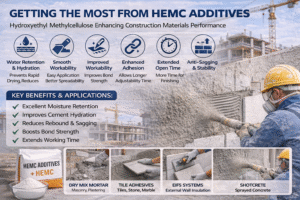
Construction grade HPMC serves different functions across building applications: it provides water retention for proper cement hydration, controls consistency and workability, prevents material sagging on vertical surfaces, improves adhesion to substrates, and extends open time for proper material placement.
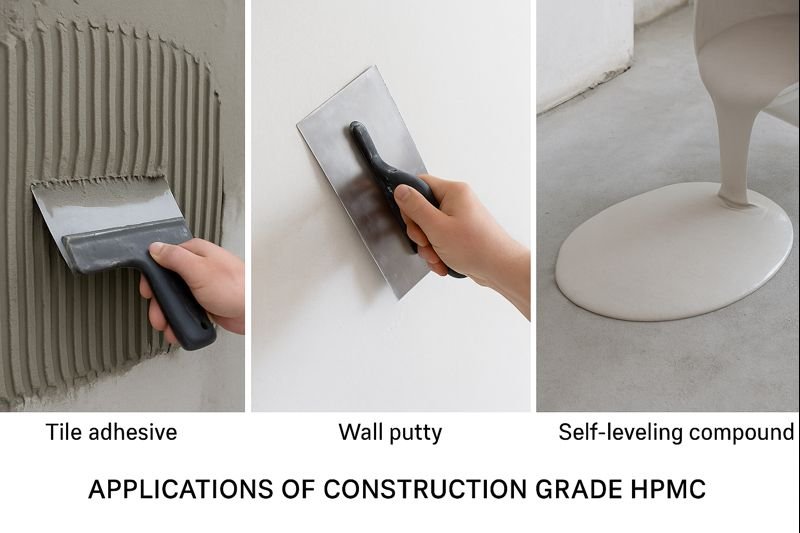
In my years visiting construction sites across developing markets, I've observed how HPMC performs in real-world conditions. Let me share some specific applications and the optimal HPMC grades for each.
Tile adhesives represent one of the most common applications for construction grade HPMC. These products require excellent water retention to prevent premature drying, good sag resistance to support heavy tiles on vertical surfaces, and extended open time to allow proper placement. Our K4M grade (30,000-50,000 mPa·s) provides the ideal balance for standard ceramic tile applications, while heavier porcelain or stone tiles benefit from our higher viscosity K5M grade (60,000-75,000 mPa·s).
The methoxyl-hydroxypropyl ratio in our tile adhesive grades is carefully balanced at approximately 2.5:1, creating strong adhesion to both porous and non-porous surfaces. One customer in Mexico switched from a competitor's product to our K4M grade and reported a 30% increase in adhesion strength due to this optimized ratio.
Exterior renders face some of the most challenging conditions, especially in hot climates. These applications require maximum water retention to prevent premature drying while maintaining workability for proper finishing. Our highest viscosity grades (K7M-K9M, 100,000-200,000 mPa·s) excel in these conditions. The long polymer chains create a robust water-retention network that maintains optimal moisture conditions for cement hydration even in extreme environments.
A large mortar manufacturer in Saudi Arabia was experiencing inconsistent quality in their exterior renders during summer months. After switching to our K8M grade (150,000-180,000 mPa·s), they reported consistent performance even when applied in direct sunlight at 45°C. The high molecular weight HPMC effectively "locked" moisture in the render, preventing flash drying and allowing proper strength development.
Self-leveling compounds represent a different challenge, requiring good flow characteristics while maintaining enough cohesion to prevent material separation. Our low viscosity grades (K1M-K2M, 4,000-15,000 mPa·s) provide the perfect balance. These grades offer sufficient water retention for proper cement hydration while allowing the material to flow easily and release entrapped air.
The particle size distribution in these grades is tightly controlled between 80-100 mesh, ensuring rapid dissolution without lumping. This is particularly important for self-leveling compounds, which typically have short mixing times on job sites.
Repair mortars and patching compounds benefit from our medium-high viscosity grades6 (K5M-K6M, 50,000-100,000 mPa·s). These applications require excellent adhesion to existing concrete, minimal shrinkage, and good workability for proper placement. The balanced methoxyl-hydroxypropyl content creates strong bonding with both the repair substrate and the cement particles.
A concrete repair company in Brazil was experiencing debonding issues with their patching compound. After switching to our K6M grade (80,000 mPa·s), they reported a 40% increase in bond strength and significant reduction in edge cracking. The higher viscosity improved both water retention and adhesion characteristics.
Joint compounds and setting-type fillers require excellent sag resistance and controlled setting time. Our high viscosity grades (K7M-K8M, 100,000-180,000 mPa·s) provide the ideal rheology for these applications. The high molecular weight creates excellent consistency for easy application while maintaining position after placement.
Conclusion
Choosing the right HPMC viscosity grade is crucial for successful construction projects. Match low viscosity grades to flowing applications, medium grades to general mortars and adhesives, and high viscosity grades to exterior applications requiring maximum water retention. The right choice leads to better performance, reduced waste, and satisfied customers.
-
Explore the versatile applications of HPMC in construction and how it enhances material performance. ↩
-
Learn how viscosity impacts the workability and effectiveness of construction materials. ↩
-
Understanding gel temperature can help you select the right HPMC for varying climate conditions. ↩
-
Discover the benefits of self-leveling compounds in achieving smooth surfaces in construction. ↩ ↩
-
Learn how to choose and apply tile adhesives for optimal adhesion and performance. ↩
-
Explore the advantages of high viscosity grades for applications requiring maximum water retention. ↩