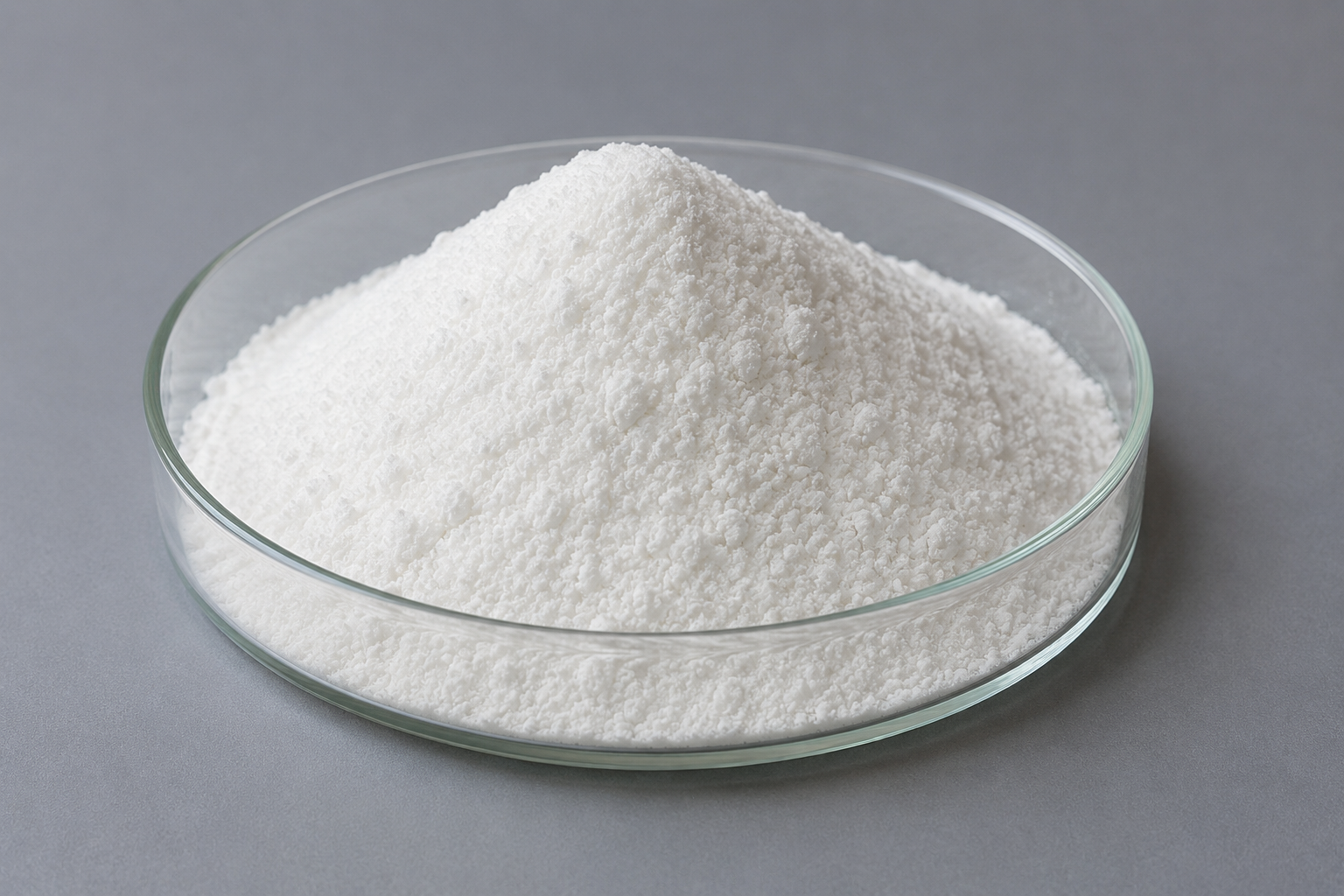
HPMC raw materials are often ignored during purchasing, but they decide the final quality of hydroxypropyl methylcellulose. If buyers only compare price, they may receive unstable viscosity, poor water retention, or mixed substitutes. The safer solution is to understand the basic raw materials before choosing an HPMC supplier.
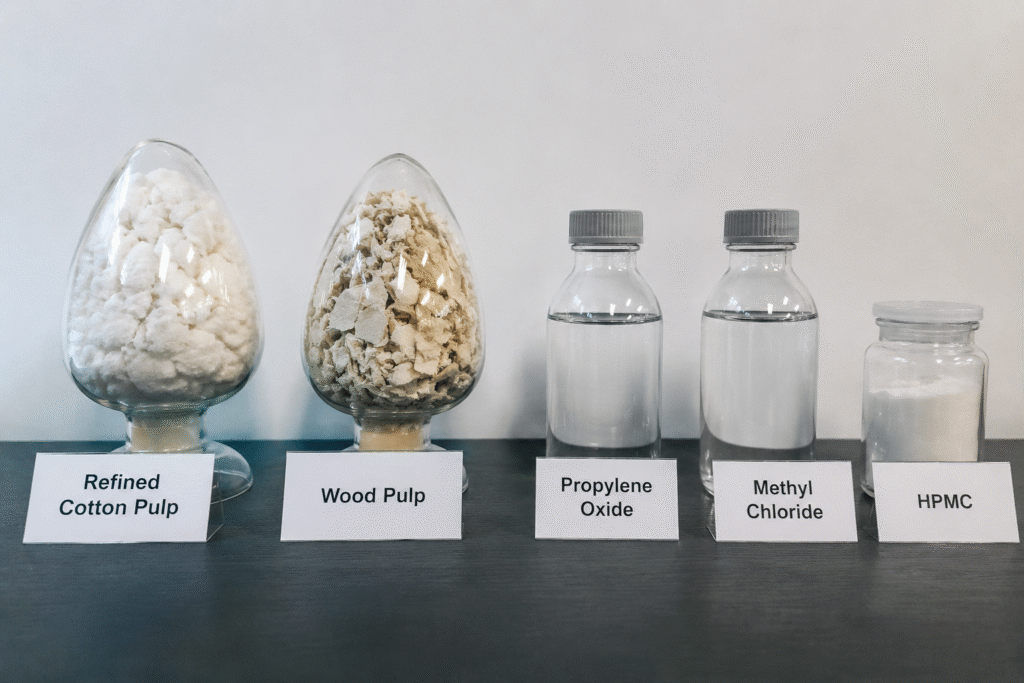
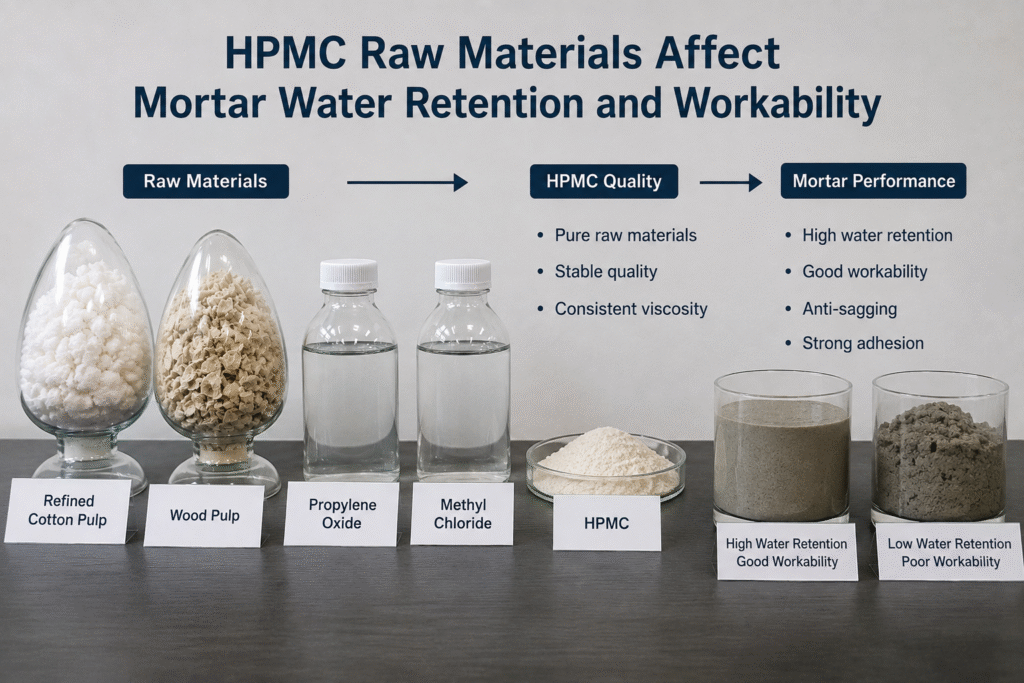
The main HPMC raw materials are refined cotton pulp or wood pulp with high α-cellulose content, usually ≥90%1, plus propylene oxide and methyl chloride2. These materials react through alkalization and etherification to produce HPMC. Better cellulose purity and controlled chemical reaction usually create more stable viscosity, water retention, and mortar performance.
Many buyers ask me about HPMC price first. I understand that. But when I help customers compare samples, I usually start from raw materials, not price. Raw material quality is one of the fastest ways to judge whether an HPMC manufacturer can supply stable products for dry mix mortar and coating factories.
What Are the Main HPMC Raw Materials Used in HPMC Production?
HPMC raw materials may look simple on paper, but small differences can create big changes in the final product. If a factory uses low-grade cellulose or poor process control, the buyer may face unstable batches, customer complaints, and higher rework costs.
The main raw materials used in HPMC production are refined cotton pulp or wood pulp, propylene oxide, methyl chloride, and alkali materials such as sodium hydroxide. Refined cellulose provides the main molecular structure. Propylene oxide adds hydroxypropyl groups, while methyl chloride adds methoxy groups.
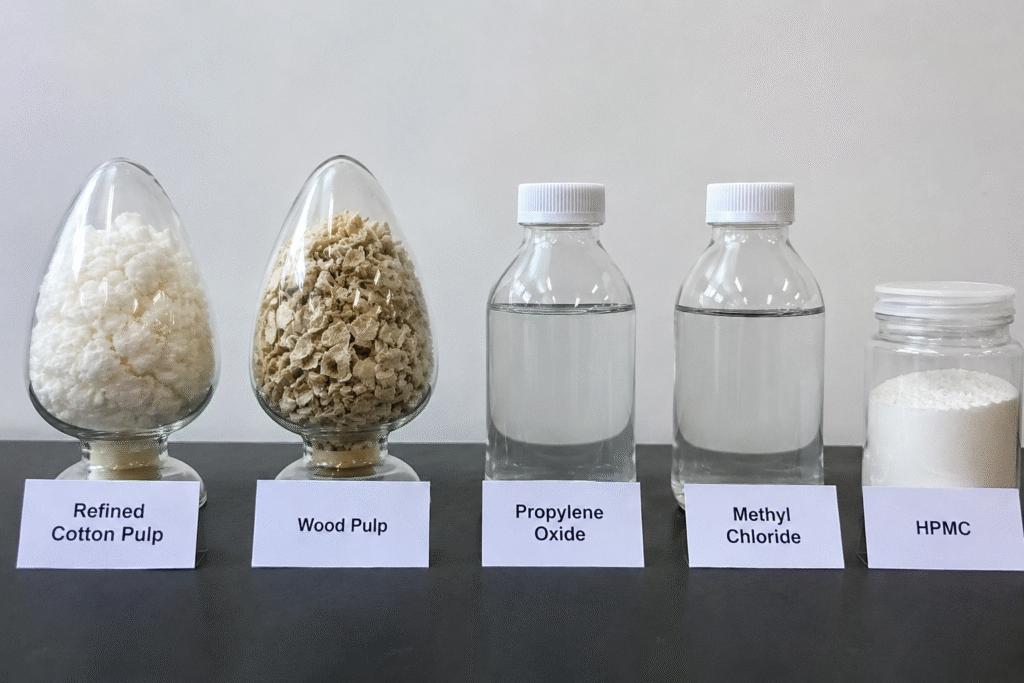
The basic raw material structure of HPMC
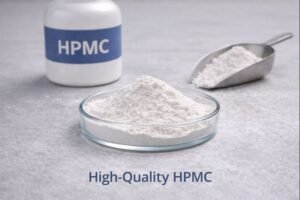
HPMC means hydroxypropyl methylcellulose. It is a non-ionic cellulose ether. In simple words, manufacturers take natural cellulose and modify it by chemical reaction. The result is a powder that can improve water retention, workability, open time, sag resistance, and adhesion in construction materials.
For procurement teams, the key point is this:
HPMC quality starts from cellulose quality, then depends on etherification control, washing, drying, grinding, and batch testing.
The basic raw material chain usually looks like this:
| Raw material | Function in HPMC production | What buyers should check |
|---|---|---|
| Refined cotton pulp | Main cellulose source | α-cellulose content, purity, ash content |
| Wood pulp | Alternative cellulose source | Stability, source, fiber quality |
| Propylene oxide | Adds hydroxypropyl groups | Substitution level and reaction control |
| Methyl chloride | Adds methoxy groups | Substitution level and reaction consistency |
| Sodium hydroxide | Used for alkalization | Process control and impurity control |
| Water and solvents | Used in reaction and washing | Residue control and environmental management |
Refined cotton pulp vs. wood pulp
Both refined cotton pulp and wood pulp can be used to produce HPMC. In many construction-grade HPMC products, refined cotton is common because it can offer high cellulose purity and good reaction stability. Wood pulp can also work when the quality is controlled well.
A serious buyer should not simply ask, “Do you use cotton or wood?” A better question is:
- What is the α-cellulose content?
- Is it ≥90%?
- Is the pulp source stable?
- Do you test incoming cellulose pulp?
- Can you keep viscosity stable from batch to batch?
Why propylene oxide and methyl chloride matter
Propylene oxide and methyl chloride are not just “chemicals.” They decide the substitution structure of HPMC.
In HPMC, two important values are:
- Methoxy content3
- Hydroxypropoxy content
These values affect gel temperature, water solubility, thickening efficiency, and performance in mortar systems4. If the reaction is not controlled well, two products with the same viscosity number can still perform differently in tile adhesive, skim coat, plaster, or self-leveling mortar.
My purchasing view
When I talk with buyers from the Middle East or Southeast Asia, they often say, “I need the same quality but 20% cheaper.” I respect cost pressure. However, I also remind them that some low-price products may use low substitution HPMC or HEC-blended alternatives. These may reduce cost by about 20–30%, but they can change water retention, setting behavior, and final mortar stability.
So I suggest buyers compare not only price, but also:
- Viscosity curve
- Water retention test
- Mortar open time
- Ash content
- Moisture content
- Substitution degree
- Batch-to-batch stability
- Supplier test reports
Why Is Refined Cotton Important for HPMC Quality?
Refined cotton is important because HPMC production depends on clean and reactive cellulose. If the cellulose source has low purity, high ash, or unstable fiber quality, the final HPMC may show poor viscosity control and uneven performance in dry mix mortar.
Refined cotton is a high-purity cellulose source for HPMC. Good refined cotton pulp usually has high α-cellulose content, often ≥90%. This helps the etherification reaction become more stable, which supports consistent viscosity, better water retention, and more reliable performance in cement-based products.
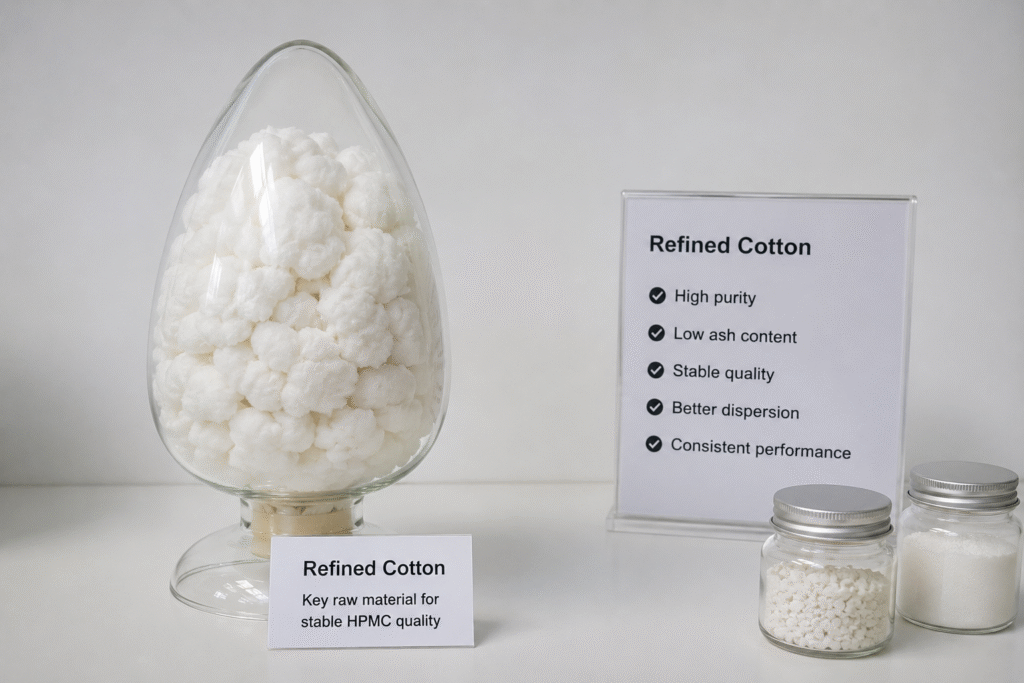
What is refined cotton?
Refined cotton is processed cotton linters. Cotton linters are short fibers left on cotton seeds after ginning5. After purification, bleaching, and refining, they become high-purity cellulose pulp.
For HPMC production, the most important part is α-cellulose. This is the main useful cellulose fraction. In many quality-focused HPMC factories, buyers expect α-cellulose content to be 90% or higher.
When α-cellulose is high, the cellulose has better purity and more predictable reaction behavior. When α-cellulose is low, the raw material may contain more hemicellulose, lignin, ash, or other impurities. These impurities can affect reaction efficiency and final product stability.
How refined cotton affects HPMC performance
The influence of refined cotton is not always visible from the powder appearance. Many HPMC powders look similar. They are white or off-white. They flow well. They may have similar viscosity labels.
But in mortar testing, differences become clear.
Good refined cotton can support:
- Stable viscosity across different batches
- Better water retention in cement mortar
- More consistent workability
- Lower risk of lumps when dispersed properly
- More predictable gel temperature
- Better compatibility with cement, gypsum, and fillers
Poor cellulose pulp can create problems such as:
- Viscosity drift
- Weak thickening effect
- Poor water retention
- Different performance between shipments
- More customer complaints after production
Simple example from procurement testing
I once compared two HPMC samples with the same labeled viscosity. On paper, both were “200,000 mPa·s.” In a simple mortar test, one sample gave smooth troweling and good water retention. The other sample felt sticky at first, then lost workability faster.
The difference was not only viscosity. It came from raw material quality, substitution control, and production consistency.
That is why I do not advise buyers to purchase HPMC only by viscosity number.
Buyers can ask suppliers for a basic quality file. This does not replace professional laboratory evaluation, but it helps filter weak suppliers.
| Indicator | Why it matters | Common buyer concern |
|---|---|---|
| α-cellulose content | Shows cellulose purity | Lower purity may reduce stability |
| Ash content | Indicates inorganic residue | High ash may affect mortar behavior |
| Moisture content | Affects storage and dosage | High moisture may reduce effective content |
| Whiteness | Basic appearance indicator | Not equal to performance |
| Viscosity | Shows thickening level | Must be tested under standard method |
| Substitution values | Show chemical modification level | Affects water retention and gel temperature |
My advice to serious buyers
If you are a distributor, mortar factory, or coating factory, I suggest you keep reference samples from every approved batch. You can compare new shipments against the approved sample.
A simple internal control system can include:
- Keep a sealed sample from each shipment.
- Record batch number and production date.
- Test viscosity under the same method.
- Run a small mortar application test.
- Check water retention or open time.
- Compare color, smell, and powder flow.
This process does not need to be complicated. But it can protect you from unstable raw materials and low-cost replacement products.
How Do HPMC Raw Materials Affect Performance?
HPMC raw materials affect performance because they control the molecular structure, purity, viscosity stability, and substitution level of the final product. If raw materials are unstable, the same dosage may give different results in tile adhesive, wall putty, plaster, or other dry mix products.
High-quality HPMC raw materials help improve water retention, thickening, workability, open time, and anti-sag performance. Low-quality or mixed raw materials may reduce performance, even when the viscosity label looks similar. Buyers should always test HPMC in the final application formula.
Performance is not only viscosity
Many buyers focus on viscosity first. This is normal because viscosity is easy to compare. However, viscosity alone cannot show the full performance of HPMC.
Two HPMC products may have the same viscosity, but different:
- Water retention
- Solubility speed
- Gel temperature
- Mortar open time
- Slip resistance
- Workability
- Compatibility with cement and additives
- Stability during storage
This is why I always suggest application testing. A technical data sheet is useful, but the final decision should come from real mortar or coating trials.
Main performance areas affected by HPMC raw materials
| Performance area | Raw material influence | What buyers may see |
|---|---|---|
| Water retention | Cellulose purity and substitution control | Faster or slower water loss |
| Thickening | Molecular weight and viscosity stability | Different mortar consistency |
| Workability | Particle size and solubility | Smooth or sticky hand feel |
| Open time | Water retention and film behavior | Longer or shorter application window |
| Anti-sag | Viscosity and rheology | Tile slip or better hold |
| Batch stability | Raw material and process consistency | Stable or changing performance |
The risk of low-substitution HPMC and HEC blends
In some developing markets, especially parts of the Middle East and Southeast Asia, buyers may face strong price competition. I have seen cases where products are sold as HPMC, but the formulation may include low-substitution HPMC or HEC blended substitutes.
HEC means hydroxyethyl cellulose. It is also a cellulose ether, but it is not the same as HPMC. HEC can be useful in some coatings and other systems. However, when it is used as a hidden replacement in dry mortar applications, the performance may change.
The purpose is often cost reduction. Some blended products can reduce cost by around 20–30%. But buyers should be careful because lower cost may also mean:
- Lower water retention in cement mortar
- Different thickening behavior
- Poorer open time
- Unstable performance in hot climates
- Formula adjustment problems
- More difficult customer complaint handling
This issue is especially important for buyers in hot areas such as Saudi Arabia, UAE, and other Middle East markets. High temperature can make poor water retention more obvious.
How climate affects HPMC selection
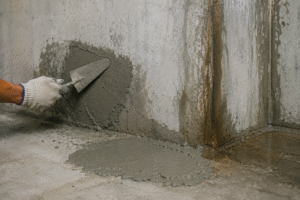
In hot and dry climates, mortar loses water faster6. If HPMC raw materials and substitution control are weak, workers may see:
- Short open time
- Fast surface drying
- Poor adhesion
- Hard troweling
- Increased cracking risk
- More tile adjustment problems
For markets such as Saudi Arabia, UAE, India, Pakistan, Malaysia, and the Philippines, buyers should test HPMC under local temperature and humidity when possible.
Practical testing points for buyers
A good HPMC sample should not only pass laboratory viscosity testing. It should also perform well in the real formula.
I suggest buyers run these simple checks:
-
Dry powder appearance
- Check color, smell, flow, and lumps.
-
Dissolution test
- Compare dispersion speed and lump formation.
-
Viscosity test
- Use the same concentration, temperature, and instrument each time.
-
Mortar trial
- Test workability, water retention, open time, and sag resistance.
-
Heat condition test
- If your market is hot, test at higher room temperature.
-
Batch comparison
- Compare at least two or three batches before large orders.
My commercial view
A cheaper HPMC is not always bad. A more expensive HPMC is not always good. The correct product is the one that fits your formula, climate, target price, and customer expectation.
But if the price is much lower than the market average, I always ask one more question:
Is the lower price coming from better production efficiency, or from lower-grade raw materials and hidden blending?
That question can save a buyer from many problems.
How to Evaluate the HPMC Raw Material Quality of an HPMC Manufacturer?
Evaluating HPMC raw material quality is difficult if the supplier only gives a price and a simple data sheet. A buyer may place an order quickly, but later face delayed shipments, unstable quality, or documents that cannot be verified.
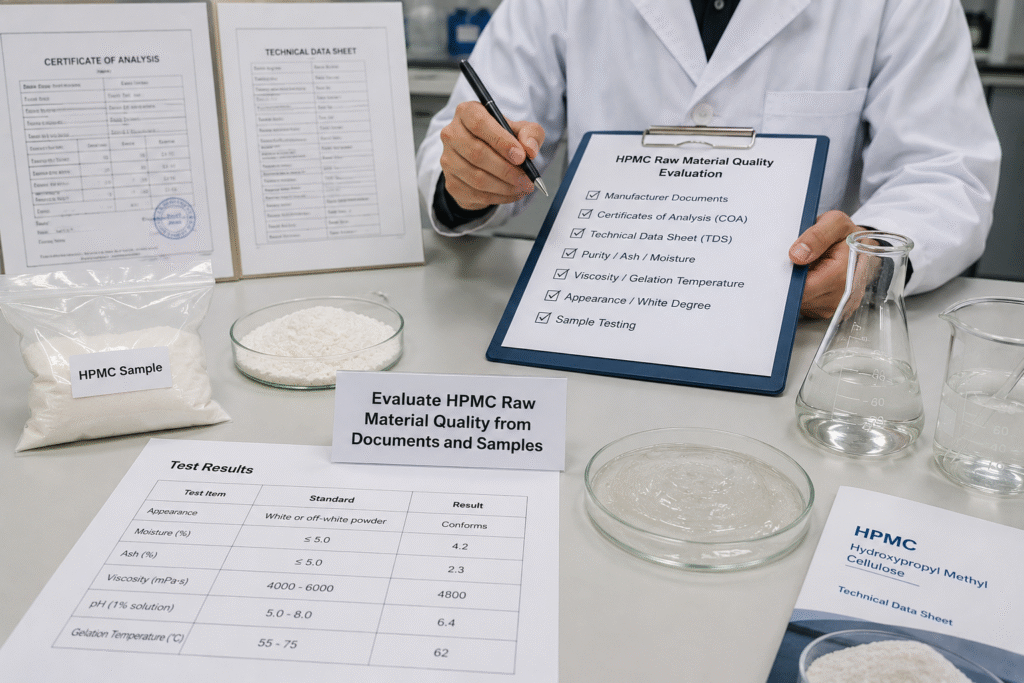
To evaluate the HPMC raw material quality of a manufacturer, buyers should review cellulose source, α-cellulose content, substitution values, batch test reports, production control, certifications, and application samples. They should also verify ISO or CE documents directly and test samples in their own formula before bulk purchase.
Start with supplier questions
A reliable HPMC manufacturer should be able to answer basic raw material questions clearly. The answer does not need to reveal every trade secret. But the supplier should show a real quality control system.
You can ask:
- Do you use refined cotton pulp, wood pulp, or both?
- What is the typical α-cellulose content?
- Do you inspect incoming pulp?
- How do you control methoxy and hydroxypropoxy content?
- What viscosity methods do you use?
- Can you provide batch COA?
- Can you provide retained samples if there is a complaint?
- Can you support application testing for dry mix mortar?
If a supplier avoids every technical question, I would be careful.
Review documents, but verify them
Documents are important in B2B purchasing. ISO and CE documents can help buyers understand a supplier’s management and export readiness. However, buyers should treat these as documents to verify, not as automatic proof of product quality.
For example, in my own factory context, we work with imported German production lines and maintain ISO and CE-related documents for buyer review. We also support batch testing and export documentation. Still, I always tell serious buyers to check certificates carefully and test the product in their own application.
Buyers can verify:
| Document | Why it matters | How to check |
|---|---|---|
| ISO certificate | Shows management system | Check issuer and validity |
| CE document | Supports market compliance needs | Confirm product scope |
| COA | Shows batch test data | Match batch number with shipment |
| TDS | Shows typical product values | Compare with test results |
| MSDS/SDS | Supports safety handling | Check language and latest version |
| Export records | Shows experience | Ask for general market references |
Inspect production and quality control ability
For large distributors and factories, supplier stability matters as much as sample quality. A perfect sample is not enough if mass production cannot repeat it.
When evaluating an HPMC manufacturer, I suggest checking:
- Production line capacity
- Raw material storage
- Incoming inspection
- Reaction process control
- Washing and drying system
- Grinding and sieving control
- Final product testing
- Packaging quality
- Warehouse management
- Export loading experience
In our business context, daily production capacity can reach up to 80 tons, supported by multiple production lines. This kind of capacity matters for buyers who cannot accept shipment delays before peak season. But capacity should always be checked together with quality control, not alone.
Test supplier stability before big orders
A common mistake is to approve one sample and then place a large order immediately. I do not recommend this.
A safer process is:
-
Ask for technical discussion first
- Share your application: tile adhesive, wall putty, plaster, coating, or other product.
-
Request samples
- Ask for the exact grade you plan to buy.
-
Run internal testing
- Test viscosity, water retention, and real application behavior.
-
Order a trial quantity
- Use it in real production if possible.
-
Compare batch consistency
- Check whether bulk goods match the approved sample.
-
Build a supplier scorecard
- Include price, quality, delivery, communication, and document accuracy.
Supplier scorecard example
| Evaluation item | Weight | What to check |
|---|---|---|
| Product performance | 30% | Mortar test, water retention, workability |
| Batch stability | 25% | COA, retained samples, repeat orders |
| Price competitiveness | 15% | Total cost, not only unit price |
| Delivery reliability | 15% | Lead time, shipping documents, loading |
| Certifications and documents | 10% | Verified ISO, CE, SDS, COA |
| Communication | 5% | Fast, clear, technical support |
Watch for red flags
Some warning signs are easy to miss during price negotiation.
Be careful if you see:
- Price is much lower than normal market level.
- Supplier cannot explain raw material source.
- COA data looks copied for every batch.
- Certificates cannot be verified.
- Sample quality is good, but bulk quality changes.
- Supplier refuses application testing discussion.
- Delivery date changes many times without clear reason.
- Packaging looks different from the agreed version.
For buyers like Mark Chen, who understand negotiation and testing, these signs are important. A strong buyer should not only push price. A strong buyer should also control risk.
Frequently Asked Questions
What is the most important raw material for HPMC?
The most important raw material for HPMC is high-purity cellulose, usually from refined cotton pulp or wood pulp. Buyers should pay attention to α-cellulose content, ideally ≥90%, because cellulose purity strongly affects viscosity stability, water retention, and final mortar performance.
Is refined cotton HPMC always better than wood pulp HPMC?
Refined cotton HPMC is often preferred for stable construction-grade products, but wood pulp HPMC can also perform well if the pulp quality and production process are controlled. Buyers should compare test results, not only the raw material name.
Can HEC replace HPMC in dry mix mortar?
HEC can be used in some building material systems, but it is not a direct replacement for HPMC in every dry mix mortar formula. Hidden HEC blending may reduce cost, but it can change water retention, open time, and workability. Buyers should test before approval.
Why do two HPMC products with the same viscosity perform differently?
Two HPMC products with the same viscosity can perform differently because of cellulose purity, substitution level, particle size, solubility, and production control. Viscosity is only one indicator. Real mortar testing is necessary for final selection.
How can I avoid buying low-quality HPMC?
You can reduce risk by asking for raw material information, verifying certificates, checking COA data, testing samples in your own formula, and comparing bulk goods with approved samples. You should also avoid suppliers who offer very low prices but cannot explain quality control.
Conclusion
HPMC raw materials directly influence the quality, stability, and application performance of hydroxypropyl methylcellulose. The key materials are refined cotton pulp or wood pulp with high α-cellulose content, plus propylene oxide and methyl chloride. For serious buyers, price comparison is not enough. You should verify documents, test samples, and check batch stability before bulk orders. If you need stable HPMC for dry mix mortar, coatings, or distribution, contact us for samples, technical discussion, and export support.
-
"What is Sodium Carboxymethyl Cellulose and How Does It ...", https://xhhpmc.com/what-is-sodium-carboxymethyl-cellulose-and-how-does-it-work/. Technical literature on cellulose ether manufacturing indicates that dissolving-grade pulp with α-cellulose content exceeding 90% is typically required to achieve consistent etherification and predictable product properties (see, e.g., Klemm et al., Comprehensive Cellulose Chemistry, Wiley-VCH). Evidence role: general_support; source type: paper. Supports: That high α-cellulose content (≥90%) in dissolving-grade or chemical-grade pulp is a recognized prerequisite for cellulose ether synthesis. Scope note: Exact minimum thresholds may vary among manufacturers and are not universally codified in a single standard. ↩
-
"What are the ingredients in HPMC? - KEHAO Chemical-Expert ...", https://xhhpmc.com/what-are-the-ingredients-in-hpmc/. According to the Wikipedia entry on hypromellose and standard cellulose chemistry references, HPMC is synthesized by treating alkali cellulose with methyl chloride and propylene oxide under controlled conditions, yielding methoxy and hydroxypropyl substitution on the cellulose backbone. Evidence role: mechanism; source type: encyclopedia. Supports: That HPMC is produced by reacting alkali cellulose with methyl chloride (to introduce methoxy groups) and propylene oxide (to introduce hydroxypropyl groups). ↩
-
"What are the ingredients in HPMC? - KEHAO Chemical-Expert ...", https://xhhpmc.com/what-are-the-ingredients-in-hpmc/. Research on HPMC thermal gelation demonstrates that increasing methoxy substitution lowers the gel temperature while hydroxypropyl groups delay gelation; the USP specifies methoxy content of 19–30% and hydroxypropoxy content of 4–12% across HPMC grades (Sarkar, 1979; USP–NF monograph for Hypromellose). Evidence role: mechanism; source type: paper. Supports: That the methoxy and hydroxypropoxy substitution levels in HPMC govern its thermal gelation temperature, water solubility, and rheological behavior. Scope note: Exact performance outcomes also depend on molecular weight and testing conditions, not substitution alone. ↩
-
"Why Does HPMC Substitution Degree Affect Paint Performance in ...", https://whhpmc.com/why-does-hpmc-substitution-degree-affect-paint-performance-in-hot-climates/. Pourchez et al. (Cement and Concrete Research, 2010) demonstrated that the degree of methyl and hydroxypropyl substitution in cellulose ethers significantly affects their water retention capacity and thermal gelation onset in fresh cement mortars. Evidence role: mechanism; source type: paper. Supports: That HPMC substitution parameters directly influence gel temperature and water retention capacity in cement-based mortars. Scope note: Performance in specific mortar formulations also depends on cement type, additives, and ambient conditions. ↩
-
"Cotton", https://en.wikipedia.org/wiki/Cotton. Cotton linters are defined as the short fibers remaining on cottonseed hulls after the longer staple fibers are removed by ginning; they serve as a principal raw material for dissolving-grade cellulose pulp (Wikipedia, 'Cotton'). Evidence role: definition; source type: encyclopedia. Supports: That cotton linters are the short cellulose fibers adhering to cottonseed after ginning, used as a high-purity cellulose feedstock. ↩
-
"How Temperature Affects Cement-Based Tile Adhesives", https://xhhpmc.com/how-temperature-affects-cement-based-tile-adhesives-strength-curing-performance/. Research on fresh mortar behavior under varying environmental conditions confirms that high temperature and low humidity accelerate surface evaporation, increasing the demand for effective water-retaining admixtures such as cellulose ethers (Cultrone et al., Construction and Building Materials, 2007). Evidence role: general_support; source type: paper. Supports: That elevated ambient temperature and low relative humidity significantly increase evaporation and water loss from fresh cementitious mortar. Scope note: The exact rate of water loss depends on mortar composition, substrate absorption, and wind conditions in addition to temperature. ↩