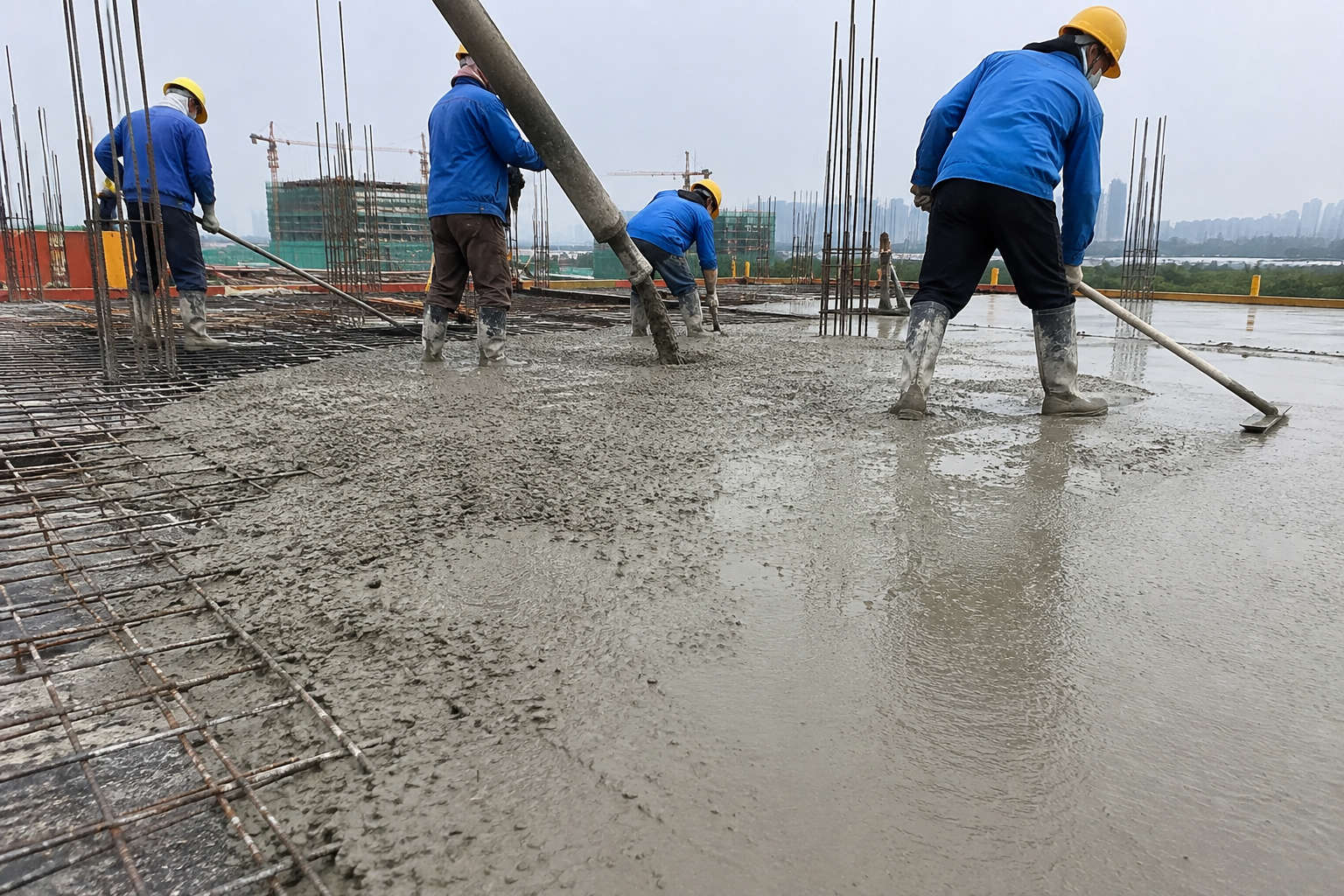
Your project is at a critical stage, but the concrete arrives looking wrong. Delays and potential structural issues loom. The solution is simple, effective on-site testing.
The most effective on-site methods to test concrete consistency are the Slump Test for standard mixes and the Flow Table Test for highly fluid or self-compacting concrete (SCC)1. These standardized tests provide a quick, reliable measure of workability before you pour, ensuring project quality from the start.
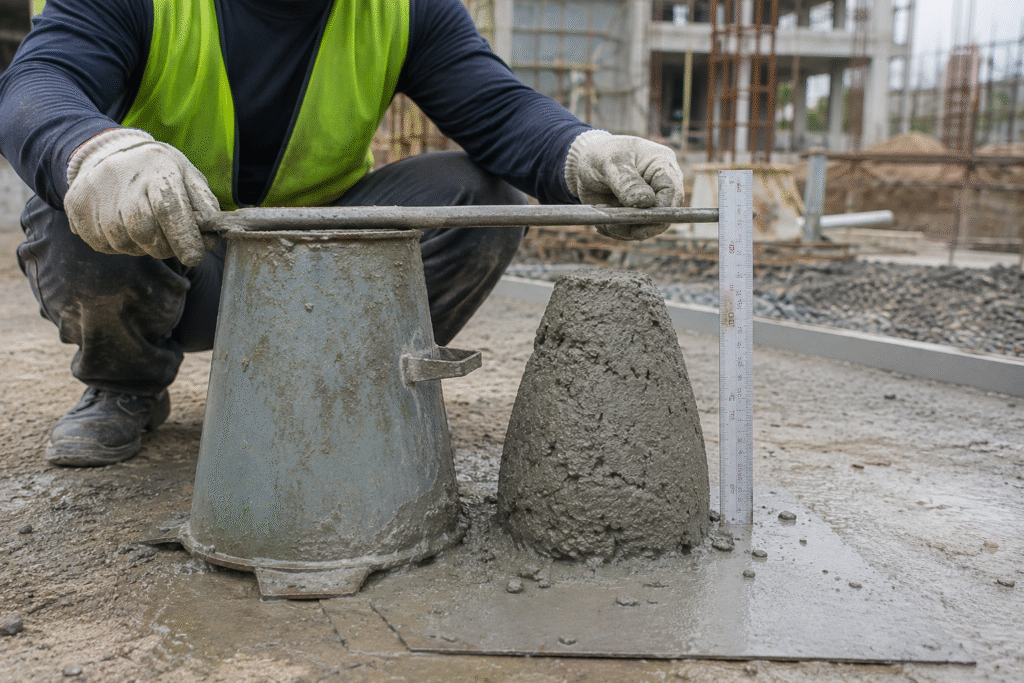
Knowing the right way to test concrete is not just about following rules. It is about taking control of your project's quality. I have seen how a simple five-minute test can prevent costly disasters. It allows you to accept or reject a concrete batch with confidence. Let's look at the best methods you can use directly on your site.
Is the Slump Test Still the Gold Standard for Concrete Consistency?
You need a reliable way to check concrete workability. But complex tests are not practical on site. A simple, trusted method is what you need to avoid project setbacks.
Yes, the Slump Test (ASTM C143 / EN 12350-2) is still the gold standard for most concrete mixes. Its simplicity, speed, and reliability make it the most common and effective way to measure the workability of fresh concrete on any construction site.
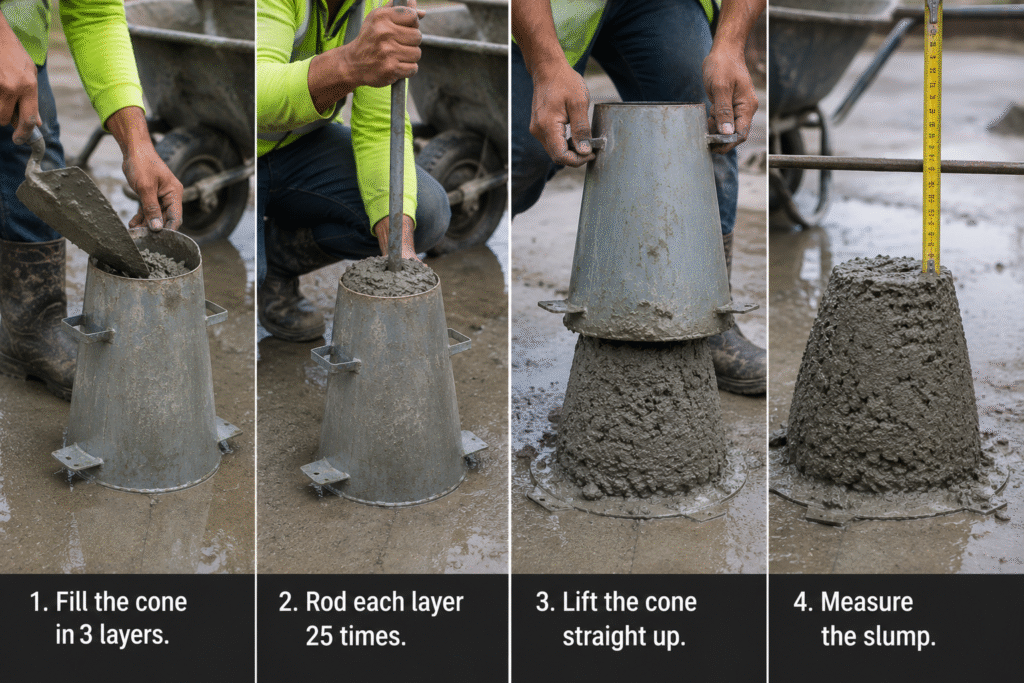
The slump test is my go-to method for standard concrete. It's a quick check that tells me a lot about the mix. The ASTM C143 standard states a slump of 150±10mm is ideal for pumped concrete. This gives you a clear target. But, you must be careful. If your aggregate size is larger than 40mm, the standard slump test is not accurate2. You need to use a different tool.
Another critical point is temperature. Many people forget this. In hot climates like Saudi Arabia or Brazil, where temperatures are often above 35°C, you must cool the slump cone. The BS EN 12350-7 standard requires pre-cooling the cone to 20±2°C. If you skip this, your results could be 8-12% too high. This could lead you to wrongly accept a bad batch of concrete.
The test itself involves a few key steps:
- Place the slump cone on a flat, non-absorbent surface.
- Fill the cone in three layers of equal volume.
- Tamp each layer 25 times with a steel rod.
- Lift the cone straight up.
- Measure the "slump," which is the distance the concrete drops.
This simple value tells you if the concrete has the right consistency for your specific application.
When is the Flow Table Test a Better Choice Than Slump?
Your concrete mix is very fluid, maybe it's self-compacting. A standard slump test won't work; the concrete will just collapse. You need a test that can handle these high-flow mixes.
The Flow Table Test (ASTM C1611 / EN 12350-5) is a better choice for highly fluid and self-compacting concrete (SCC). It measures the spread diameter of the concrete, giving a precise workability reading when a slump test would be useless.
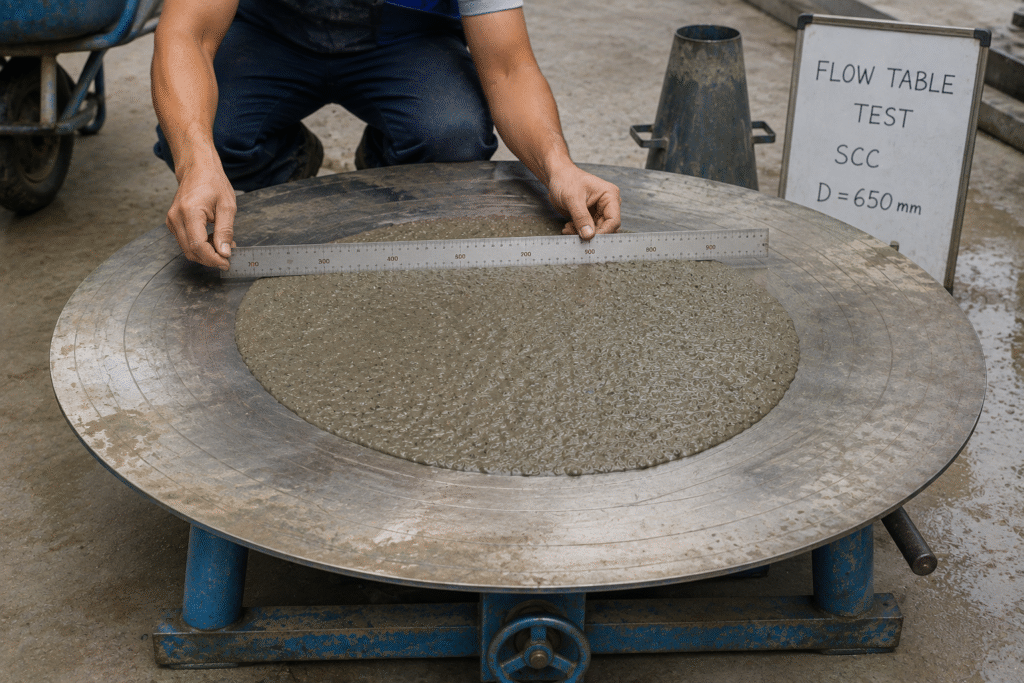
When I work with clients who use self-compacting concrete, like large paint factories that produce advanced mortars, the slump test is not an option. We always use the Flow Table test. These modern mixes are designed to flow easily into complex forms without vibration. Additives like our Kehao brand Hydroxypropyl Methylcellulose (HPMC) are key to creating this property. The flow table is the only way to measure this property correctly on site.
The test is different from a slump test:
- You place a cone (similar to a slump cone but a different size) in the center of a special table.
- You fill the cone with concrete without tamping.
- You lift the cone and let the concrete spread.
- Then, you drop the table a specified number of times, which helps the concrete flow further.
- Finally, you measure the diameter of the spread concrete.
This diameter is your result. A larger diameter means higher flowability. This test is essential for ensuring that SCC will perform as designed, filling every corner of the formwork.
How Can You Measure Both Flowability and Viscosity on Site?
You know your concrete can flow, but how fast? A mix that spreads well but moves too slowly can still cause problems like blockages in pumps. You need to measure the speed of the flow, not just the distance.
The Slump Flow and T50 test allows you to measure both flowability (spread) and viscosity (speed) on site. It involves measuring the total spread diameter and the time it takes for the concrete to reach a 50cm diameter.
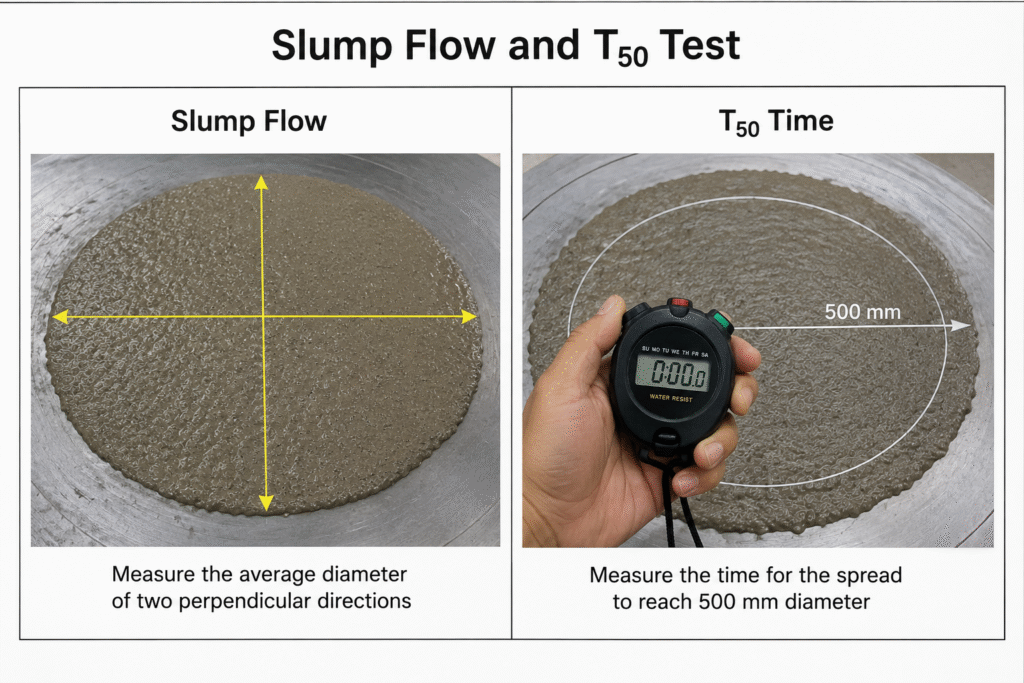
This test gives a more complete picture of the concrete's behavior, especially for SCC. The "slump flow" part is the total diameter the concrete spreads to, just like a flow table test but without the drops. The "T50" is the crucial part; it's the time in seconds from lifting the cone until the edge of the spreading concrete reaches a 50cm (500mm) circle drawn on the surface.
A low T50 time (e.g., 2-5 seconds) indicates a fluid, low-viscosity mix. A high T50 time (e.g., over 7 seconds) means the mix is more viscous and slower-moving. This is critical information for pumpability and finish quality.
For a customer like Mark Chen who prioritizes quality, this detail matters. In some advanced projects, we are seeing new technology replace manual timing. For example, digital penetrometers can measure viscosity in 30 seconds. On a project using recycled materials, we found manual tests had an error of ±15%, while the digital tool was only ±3%. This is the future of precise on-site testing.
Is There a Faster Alternative to the Slump Test?
Time is money on a construction site. The standard slump test, while essential, takes a few minutes per batch. You wonder if there's an even quicker way to get a reliable check on consistency.
Yes, the Kelly Ball Test (ASTM C360) is a faster alternative3. This test measures the penetration of a 30-pound (13.6 kg) steel ball into fresh concrete, providing a rapid estimate of consistency that correlates directly to slump.
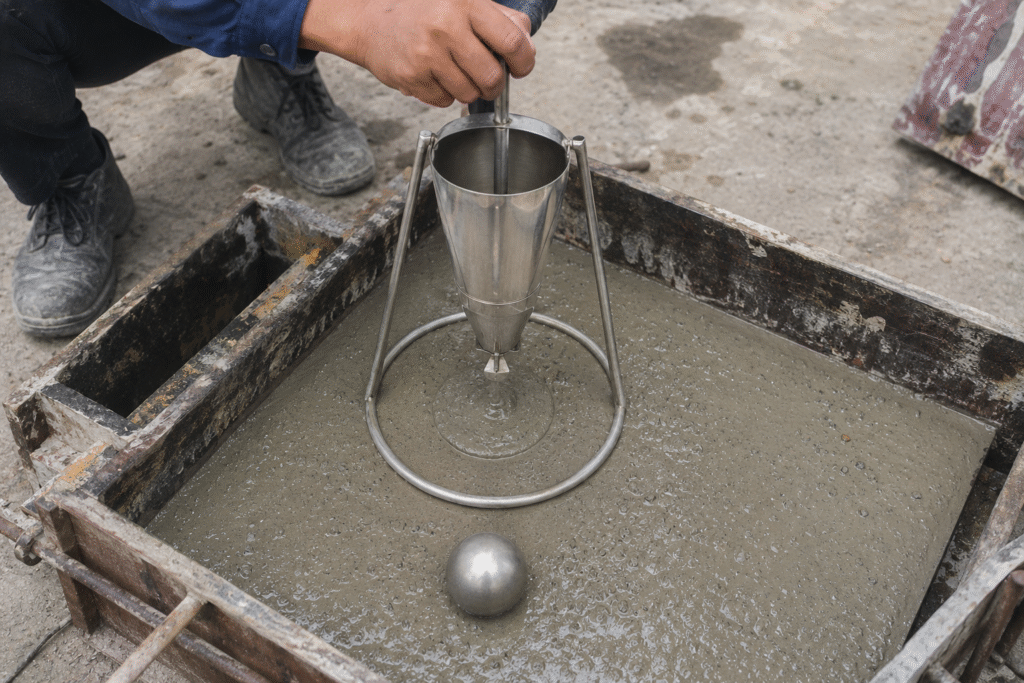
The biggest advantage of the Kelly Ball test is speed and convenience. You can perform it in seconds, and you can test the concrete directly in the wheelbarrow or the formwork. You do not need to prepare a separate sample like you do for the slump test.
Here’s how it works:
- You rest the device's frame on the fresh concrete.
- You gently release the handle, allowing the weighted "ball" (actually a hemisphere) to sink into the concrete under its own weight.
- You read the penetration depth directly from the graduated scale on the handle.
There is a simple rule of thumb for converting the measurement: The slump in inches is roughly twice the Kelly Ball penetration in inches. For example, a 2-inch penetration from the Kelly Ball suggests an approximate slump of 4 inches.
While it is very fast, it is generally considered less precise than a standard slump test. I often recommend it as a quick "spot check" to monitor consistency between full slump tests, but not as a replacement for project acceptance or rejection.
How Do You Test Very Stiff and Dry Concrete Mixes?
You are working with a mix for a road or a dam. It's a very dry, stiff concrete with almost zero slump. A slump cone won't move at all. How can you measure the workability of something that doesn't flow?
For very stiff and dry concrete mixes, you use the Vee-Bee Consistometer Test (ASTM C1170). This test measures the time it takes for vibration to remold a cone of concrete into a flat cylinder, giving a clear workability value.
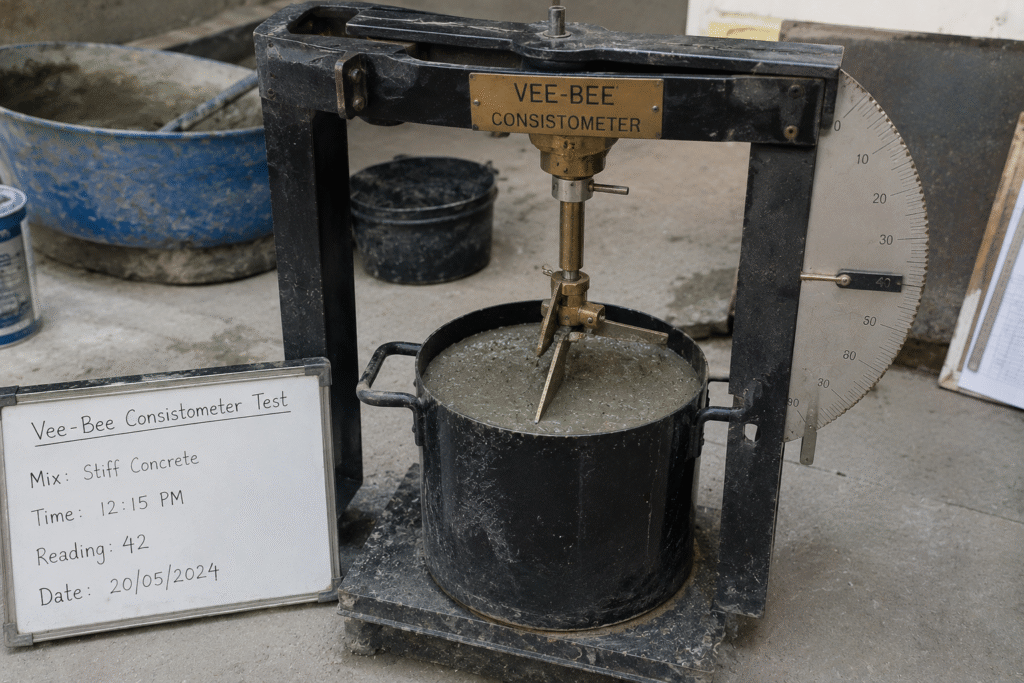
This test is specifically designed for concrete that is so stiff it has to be compacted by vibration. This is common in applications like roller-compacted concrete (RCC) for pavements and large mass concrete pours.
The equipment consists of a vibrator table, a cylindrical container, and a slump cone.
- You perform a standard slump test inside the container. The slump will likely be zero.
- You place a clear plastic disc on top of the concrete.
- You turn on the vibrator table and start a stopwatch.
- You watch as the vibration turns the cone-shaped concrete into a flat, cylindrical shape that completely fills the container.
- You stop the stopwatch as soon as the entire bottom of the plastic disc is coated with concrete paste.
The time recorded in seconds is the "Vee-Bee time." A lower time means the concrete is more workable (for a stiff mix). A higher time means it will require more effort to compact. This test gives a meaningful, repeatable number where a slump test would just tell you "zero."
Beyond Consistency, How Do You Check Overall Concrete Quality on Site?
Good consistency is important, but it's only one piece of the puzzle. Accepting a batch based on a slump test alone could be a mistake if other factors are wrong. You need a complete quality check.
To check overall concrete quality on site, you must perform a series of checks: visual inspection for uniformity, a temperature check, a consistency test like the slump test, and most importantly, casting cube or cylinder samples for later strength testing.
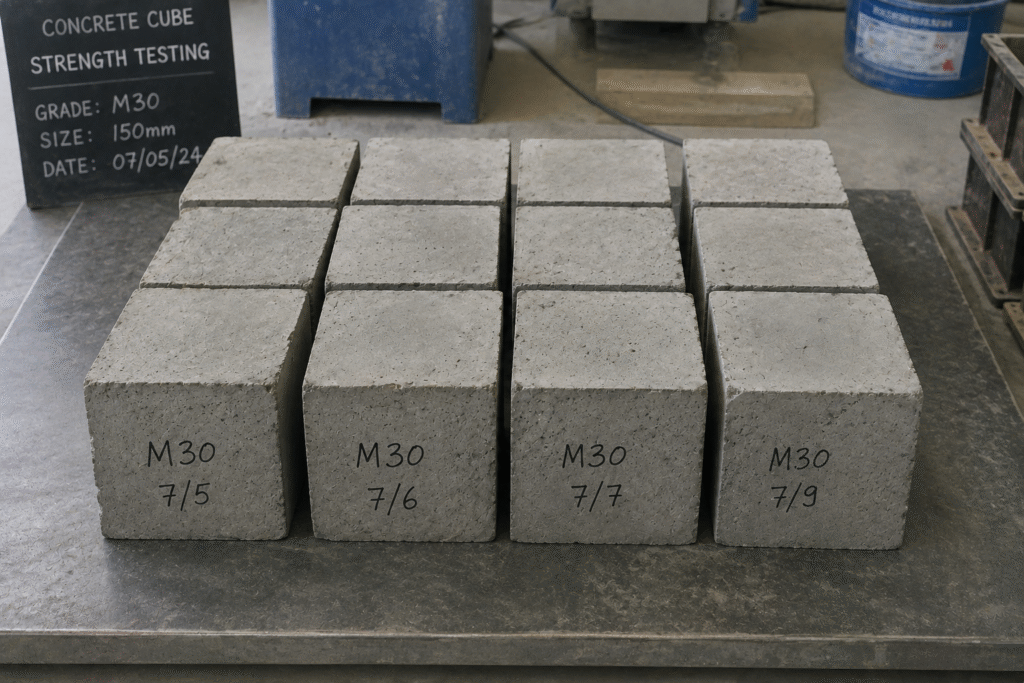
A complete on-site quality check protects you from the pain points I hear about from customers like Mark. Bad communication is one thing, but unstable product quality is a project killer. Here is a simple checklist I use with my clients to ensure they get the quality they paid for.
On-Site Concrete Quality Checklist
| Check | What to Look For | Why It's Important |
|---|---|---|
| Visual Inspection | Uniform color. No separation of stones from paste (segregation). No excessive water on top (bleeding). | A non-uniform look indicates poor mixing, which will result in weak spots. |
| Temperature Check | The concrete temperature should be within the project's specified limits (e.g., 5°C - 32°C). | Temperature affects setting time and final strength. Hot concrete sets too fast. |
| Consistency Test | Perform a slump or flow test. The result must be within the specified range for the application. | This confirms the correct workability and water-cement ratio. |
| Sample Casting | Cast standard cubes or cylinders from the batch. Label them clearly with date and batch info. | This is the ultimate proof. Strength tests at 7 and 28 days confirm if the concrete meets design specifications. |
Following this simple process on every delivery is the best way to avoid quality problems, prevent delays, and build with confidence.
What is the '4 2 1 Rule' for Concrete and Should You Use It?
You have a small job and just need a simple recipe for concrete. You've heard about the "4-2-1 rule." But is it a reliable guide, or could it lead to weak, crumbling results?
The 4-2-1 rule is a volume-based recipe: 4 parts gravel (coarse aggregate), 2 parts sand (fine aggregate), and 1 part cement. It's a rough guideline for small, non-structural jobs, but it should not be used for important structural concrete.
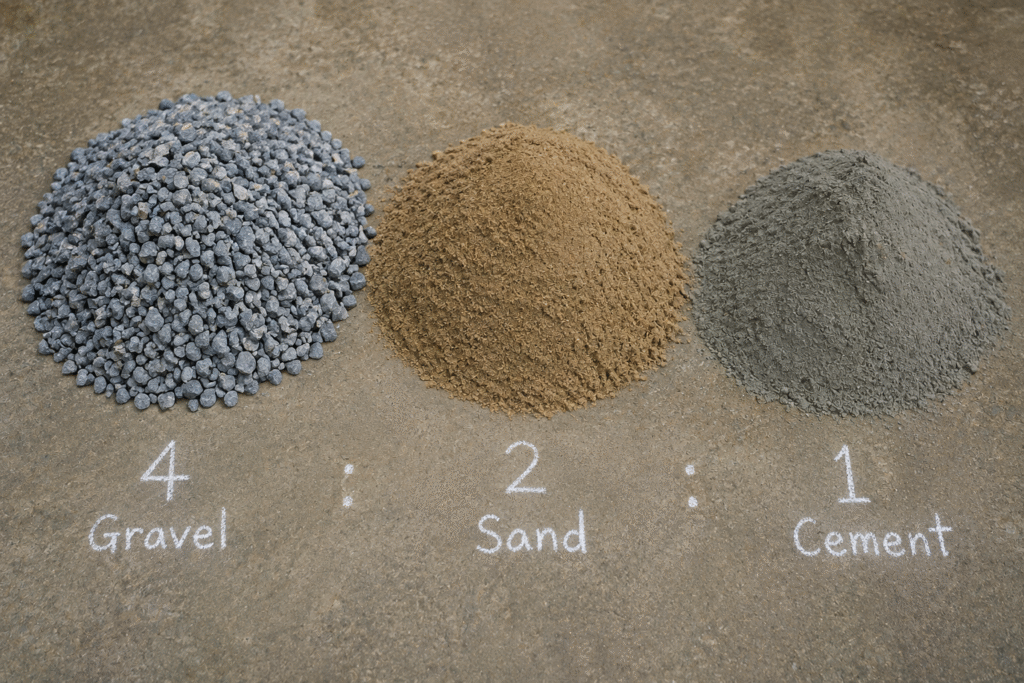
The 4-2-1 rule is easy to remember, which is why it's so popular for DIY projects. You mix the dry ingredients and then add just enough water to make the mix workable, like a thick oatmeal consistency.
However, this method has major weaknesses.
- It's based on volume, not weight. The amount of material in a shovel or bucket can vary greatly. Professional concrete is always batched by weight for accuracy.
- It doesn't control the water-cement ratio. The amount of water is the most critical factor for concrete strength. Too much water makes the mix easy to work with but creates weak concrete. The 4-2-1 rule leaves this critical step up to guesswork.
So, when is it okay to use?
| Project Type | Recommended Mix |
|---|---|
| Non-structural (e.g., mailbox post, small path) | '4-2-1' Rule (by volume) is acceptable. |
| Structural (e.g., foundation, slab, beam) | Never use it. Always use an engineered design mix specified by weight. |
For any project that needs to be strong and durable, you must use a proper design mix. The 4-2-1 rule is too risky for anything that bears a load or needs to last.
What Are the 5 C's of Concrete You Must Know?
Remembering all the details for good concrete can be overwhelming. Is there a simple framework to help you check all the important boxes? The 5 C's provide an easy way to remember the essentials for quality.
The 5 C's of concrete are: Cement, Coarse aggregates, Clean water, Correct proportions, and proper Curing. Remembering these five key elements helps ensure you produce strong, durable concrete every time, from batching to the final hardened product.
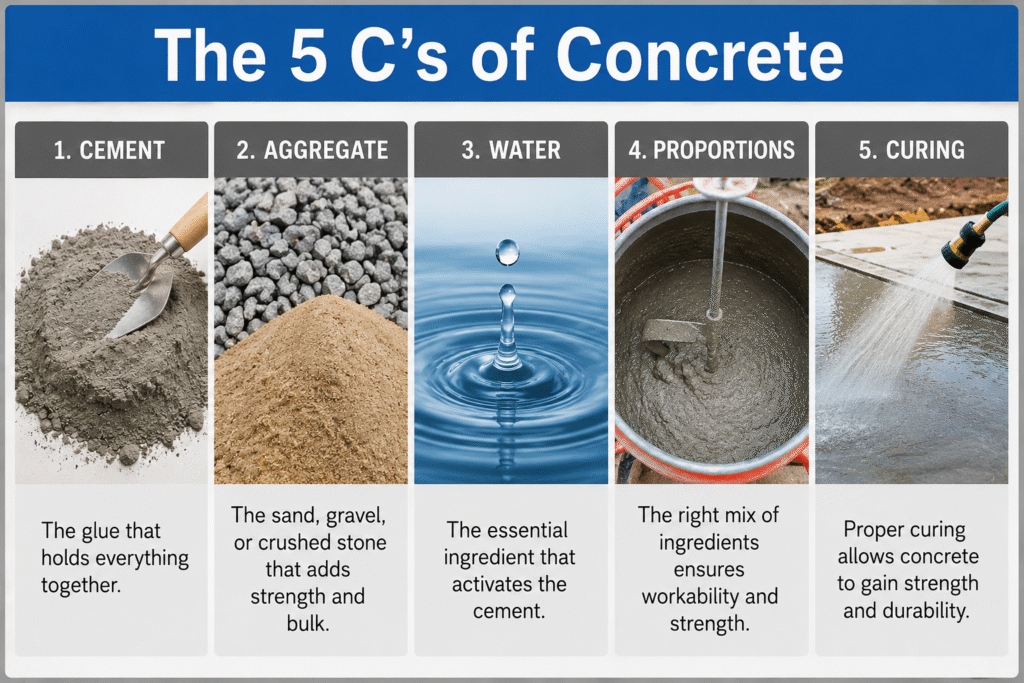
Thinking about the 5 C's helps you focus on what really matters. I tell my customers to use this as a mental checklist. Missing even one of these can compromise the entire structure. Let's break them down.
Cement
This is the powder that acts as the binder. When mixed with water, it creates a paste that coats the aggregates and hardens, gluing everything together into a solid mass. The quality of your cement is the foundation of your concrete's strength.
Coarse Aggregates
This refers to the gravel or crushed stone in the mix. It serves as an inert filler, giving the concrete bulk and dimensional stability. The size, shape, and strength of the aggregate are all important for the final product.
Clean Water
This is a critical, and often overlooked, component. The water used for mixing must be clean and free from impurities like oils, acids, salts, and organic matter. Dirty water can interfere with the chemical reaction (hydration) of the cement, resulting in weaker concrete.
Correct Proportions
This 'C' is about the recipe. As we discussed, using a weight-based engineered design mix is crucial for any structural work. A qualified engineer determines the exact proportions of cement, water, sand, and gravel to achieve a specific strength and workability.
Curing
This is the final and most neglected 'C'. After the concrete is poured and finished, it needs to be cured. Curing is the process of maintaining adequate moisture and a favorable temperature for a period of time. This allows the cement hydration process to continue so the concrete can achieve its full design strength. Curing can be done by spraying with water, covering with wet cloths, or using a liquid curing compound.
Conclusion
Choosing the right consistency test—like the slump test for regular concrete or the flow table for SCC—is vital. It ensures your concrete is workable and your project starts with quality materials.
-
"Flow table test - Wikipedia", https://en.wikipedia.org/wiki/Flow_table_test. A technical review by the American Concrete Institute and standards such as ASTM C143 and ASTM C1611 describe the slump test as the standard for conventional concrete and the flow table test as the preferred method for self-compacting concrete, supporting the claim that these are the most effective on-site methods for their respective mix types. Evidence role: expert_consensus; source type: institution. Supports: The most effective on-site methods to test concrete consistency are the Slump Test for standard mixes and the Flow Table Test for highly fluid or self-compacting concrete (SCC).. Scope note: The effectiveness of these tests may vary for specialized or non-standard concrete mixes. ↩
-
"Concrete slump test - Wikipedia", https://en.wikipedia.org/wiki/Concrete_slump_test. Concrete testing standards and technical literature note that the slump test is not suitable for concrete with aggregate sizes greater than 40mm, as larger aggregates can interfere with the test's accuracy. Evidence role: mechanism; source type: institution. Supports: If your aggregate size is larger than 40mm, the standard slump test is not accurate.. Scope note: Some modified test methods exist for larger aggregates, but the standard slump test is not recommended. ↩
-
"The correlation of Kelly Ball penetration readings with standard ...", https://scholarsmine.mst.edu/masters_theses/2189/. ASTM C360 describes the Kelly Ball test as a rapid method for estimating the consistency of fresh concrete, supporting its use as a faster alternative to the slump test. Evidence role: definition; source type: institution. Supports: the Kelly Ball Test (ASTM C360) is a faster alternative.. Scope note: The Kelly Ball test is less precise and not as widely accepted for project acceptance as the slump test. ↩