You poured concrete yesterday. Now you're worried if it's strong enough to walk on. Waiting too long costs money, but rushing risks cracks and failure.
Concrete needs 24-48 hours for initial set, 7 days to reach 70% strength, and 28 days for full design strength.1 Temperature, mix design, and curing methods change these times.2
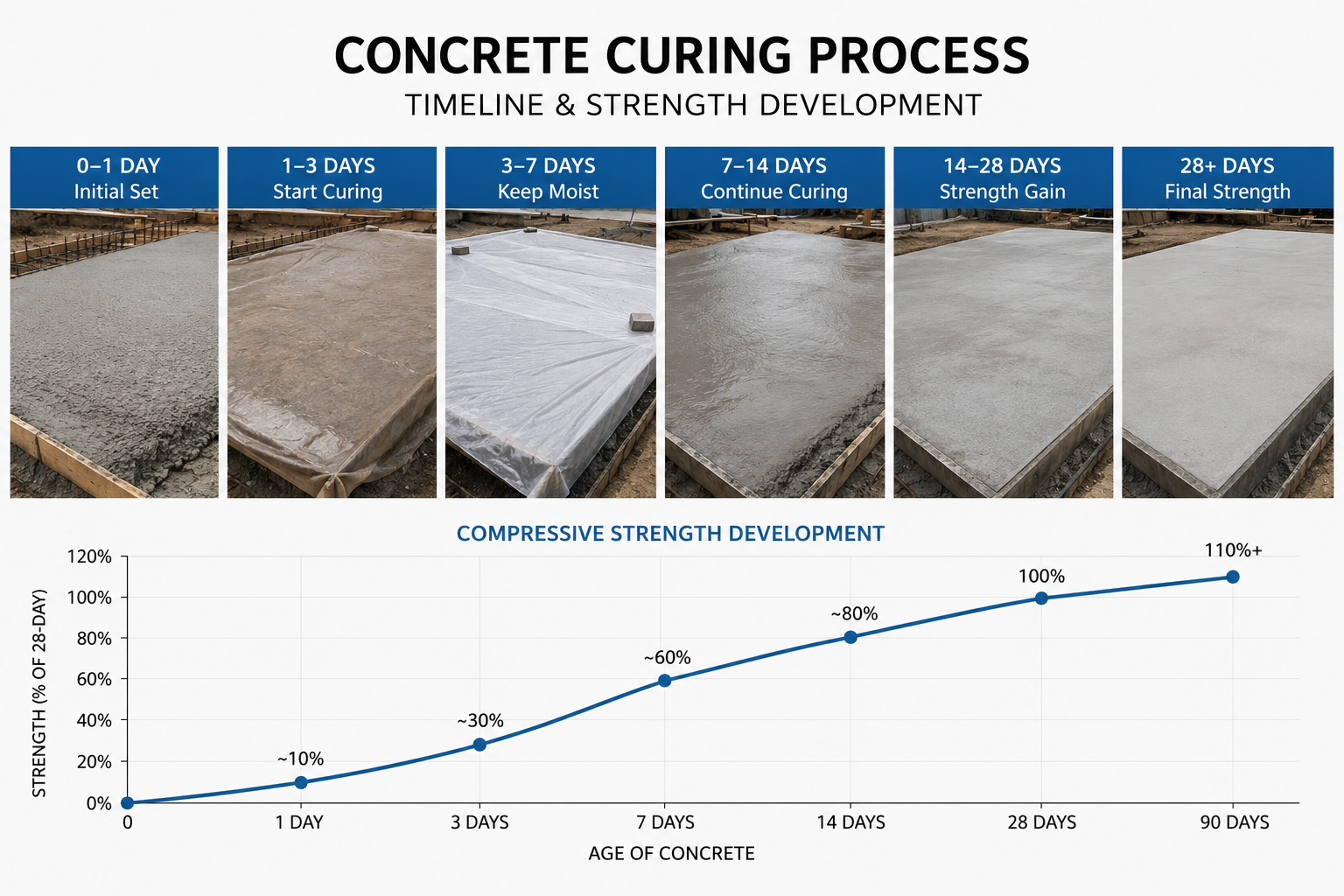
I learned this the hard way. Last year, I watched a contractor remove forms after just 12 hours. Two days later, the edges crumbled. The whole slab needed replacement. Understanding cure time saves both money and headaches.
Factors That Affect Cure Time?
Your concrete might cure faster or slower than expected. Different conditions change everything. Missing these factors leads to weak concrete and project delays.
Temperature, humidity, cement type, water-cement ratio, and additives control cure speed. Hot weather speeds curing but can cause cracks. Cold weather slows it down and may need special protection.
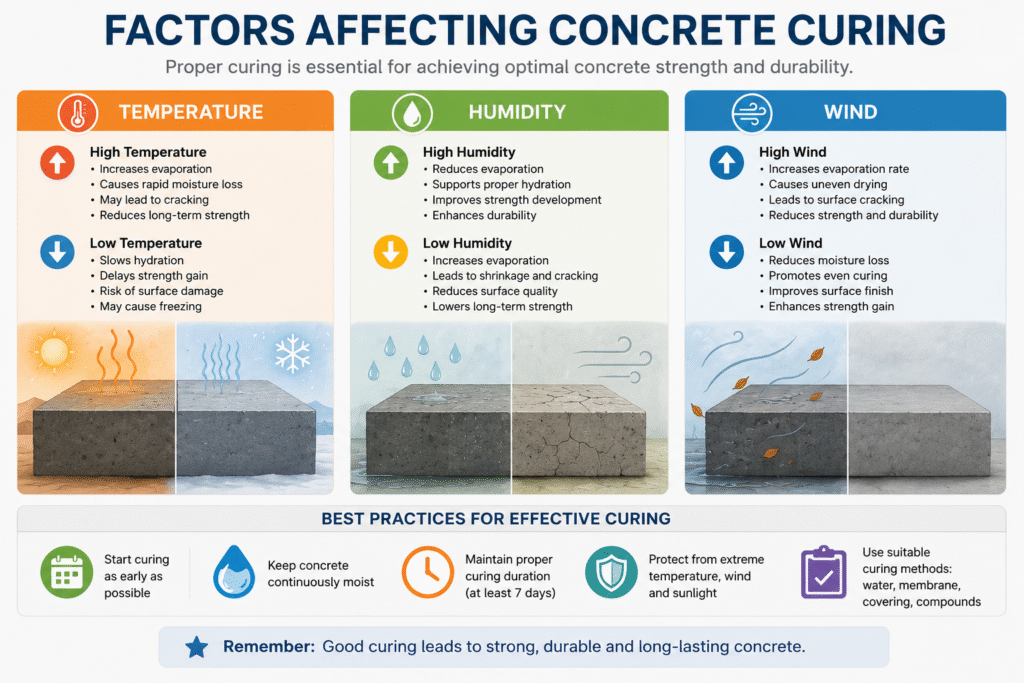
Temperature makes the biggest difference. I once worked on a project in Saudi Arabia where summer temperatures hit 45°C. We had to work at night and use ice in the mix. Here's what I've learned about each factor:
Temperature Effects
| Temperature Range | Curing Speed | Special Requirements |
|---|---|---|
| Below 10°C | Very slow | Use heated enclosures |
| 10-20°C | Normal | Standard curing |
| 20-30°C | Fast | Keep surface wet |
| Above 30°C | Too fast | Use retarders, shade |
Water-Cement Ratio Impact
Lower ratios mean stronger concrete but slower curing. Higher ratios cure faster but create weaker concrete.3 Most projects use 0.4-0.6 ratio.
Common Additives
- Accelerators: Cut cure time by 30-50%
- Retarders: Slow curing in hot weather
- Plasticizers: Improve workability without extra water
Weather changes during curing cause problems too. A 10°C temperature drop overnight can crack fresh concrete. That's why we cover slabs with plastic sheets or curing blankets.
How long does it take a 4 inch slab of concrete to cure?
A 4-inch slab feels solid after one day. But appearances lie. Walking on it too soon leaves permanent marks and weakens the structure.
A 4-inch concrete slab needs 24-48 hours before light foot traffic, 7 days before normal use, and 28 days to reach full strength.4 Keep it moist during this time for best results.
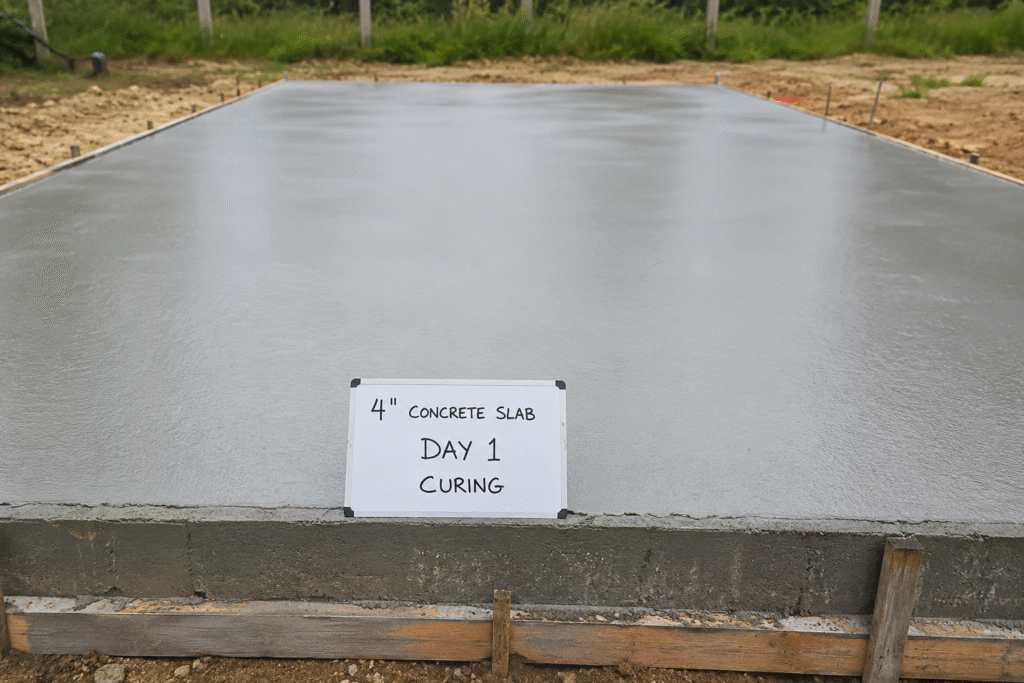
I pour 4-inch slabs regularly for warehouse floors. The thickness affects cure time less than you might think. Here's my standard timeline:
First 48 Hours
The surface hardens but stays fragile underneath. I tell clients to imagine a chocolate bar with hard shell but soft center. You can touch it, but don't put weight on it.
Days 3-7
Now it handles foot traffic and light tools. The concrete reaches about 70% strength by day 7. Still, no vehicles or heavy equipment. I mark these areas with tape.
Days 7-28
This period determines final quality. Keep the surface damp by:
- Spraying water mist twice daily
- Covering with plastic sheets
- Using curing compounds
Special Considerations for 4-inch Slabs
| Use Case | Minimum Cure Time | Notes |
|---|---|---|
| Foot traffic | 48 hours | Light walking only |
| Furniture | 7 days | Distribute weight with boards |
| Vehicles | 28 days | Cars only, no trucks |
| Heavy equipment | 45+ days | Test strength first |
Thinner slabs dry faster but also crack easier. The 4-inch thickness gives good balance between cure time and durability.
What is the 1 2 3 rule for concrete?
Many contractors mention the "1-2-3 rule" but explain it wrong. This confusion causes weak concrete and project failures.
The 1-2-3 rule means 1 part cement, 2 parts sand, 3 parts gravel by volume. This creates medium-strength concrete (about 3000 PSI) suitable for basic projects like sidewalks and foundations.
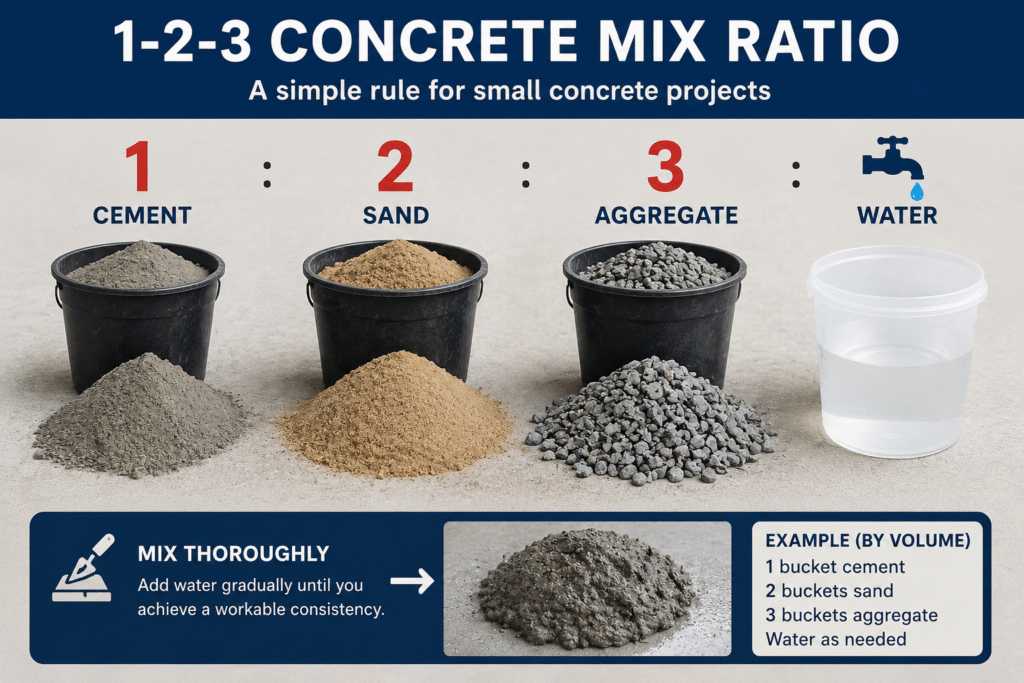
I use this mix for non-critical projects. The beauty lies in its simplicity - no scales needed, just buckets. Here's how it works in practice:
Mixing by Volume
- 1 bucket cement: Use fresh cement without lumps
- 2 buckets sand: Clean, medium-grain sand works best
- 3 buckets gravel: 3/4 inch size gives good strength
- 0.5 bucket water: Start with less, add slowly
Real-World Application
| Project Type | 1-2-3 Mix Works? | Better Alternative |
|---|---|---|
| Sidewalks | Yes | Good choice |
| Driveways | Maybe | Consider 1-2-2.5 for strength |
| Foundations | No | Use engineered mix |
| Decorative | Yes | Add colorants as needed |
Common Mistakes
People often confuse this with weight ratios. That changes everything. One cubic foot of cement weighs 94 pounds, but sand weighs 100 pounds. Using weight ratios with 1-2-3 numbers creates weak concrete.
The 1-2-3 mix gives about 3000 PSI strength after 28 days. For comparison:
- Sidewalks need 2500 PSI
- Driveways need 3500 PSI
- Foundations need 4000+ PSI
This rule works great for DIY projects. For commercial work, I calculate exact ratios based on strength requirements.
What is the 4 2 1 rule for concrete?
The 4-2-1 rule creates stronger concrete than 1-2-3. But many people apply it backwards and waste materials.
The 4-2-1 rule uses 4 parts gravel, 2 parts sand, 1 part cement by volume. This lean mix works for mass concrete like foundations where high strength isn't critical but volume matters.5
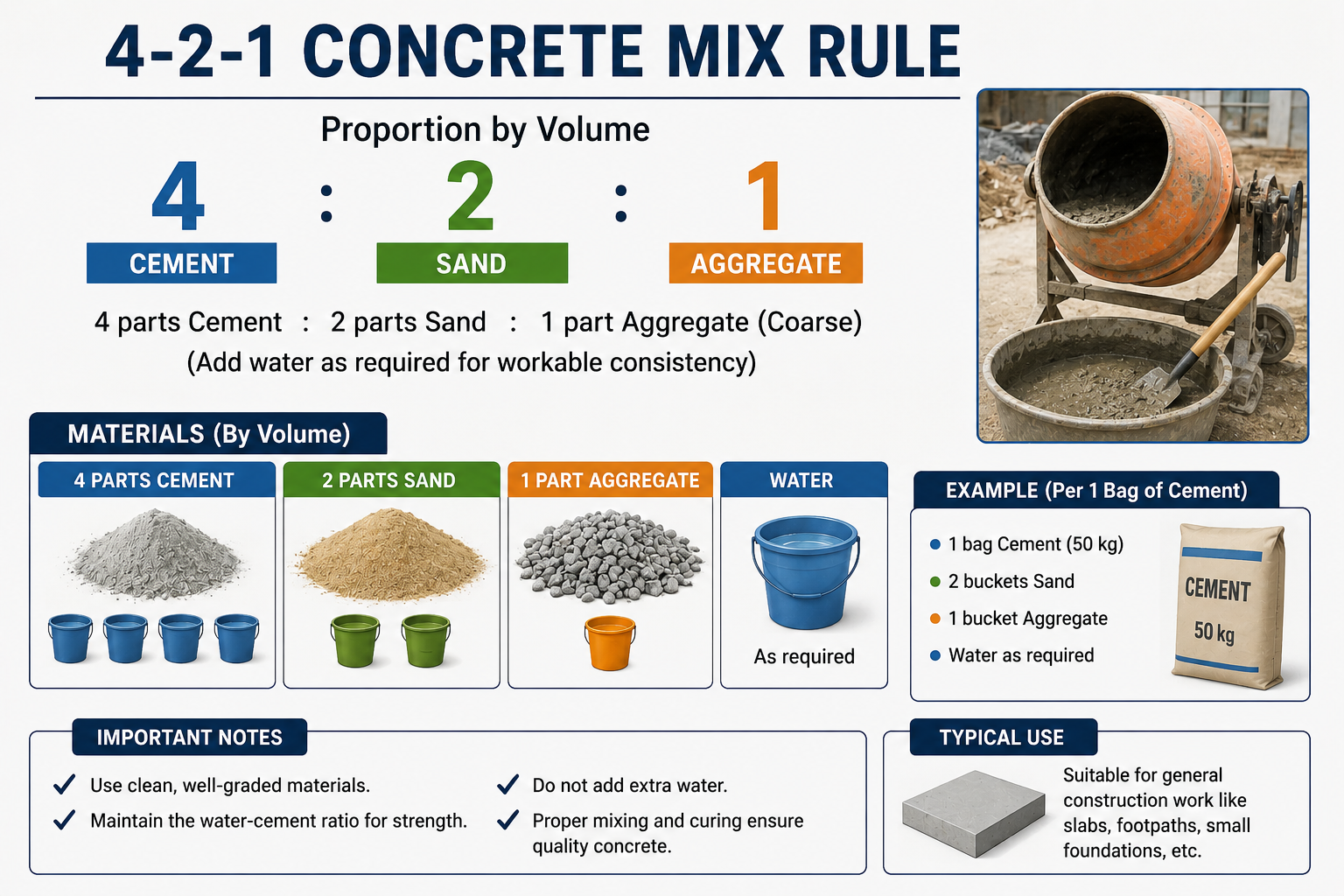
I discovered this mix working on a large foundation project. We needed lots of concrete but not extreme strength. The 4-2-1 ratio saved money without compromising safety.
When to Use 4-2-1
This mix suits specific applications:
- Mass foundations: Where volume beats strength
- Backfill concrete: Non-structural fills
- Sub-bases: Under real structural concrete
- Retaining walls: With proper reinforcement
Strength Comparison
| Mix Ratio | 28-Day Strength | Cost per Cubic Yard | Best Use |
|---|---|---|---|
| 1-2-3 | 3000 PSI | $$$ | General purpose |
| 4-2-1 | 2000 PSI | $ | Mass pours |
| 1-1.5-3 | 4000 PSI | $$$$ | Structural |
| 1-2-4 | 2500 PSI | $$ | Sidewalks |
Mixing Tips for 4-2-1
The high gravel content needs careful water control:
- Mix dry ingredients first
- Add 70% of water
- Mix thoroughly
- Add remaining water slowly
- Stop when mix flows but doesn't slump
Real Project Example
Last month, I used 4-2-1 for a warehouse foundation. The specs allowed 2000 PSI for the mass pour under the structural slab. We saved $15,000 on cement costs. The key? Understanding where strength matters and where it doesn't.
Never use 4-2-1 for:
- Driveways or parking areas
- Structural beams or columns
- Anything exposed to freeze-thaw
- High-traffic surfaces
How long should concrete cure before putting a load on it?
Loading concrete too early causes permanent damage. But waiting too long costs money. Finding the right balance keeps projects safe and profitable.
Concrete needs 7 days minimum before any significant load, 28 days for full design loads. Light foot traffic works after 24-48 hours. Heavy equipment and vehicles need 28+ days depending on concrete strength and load weight.6
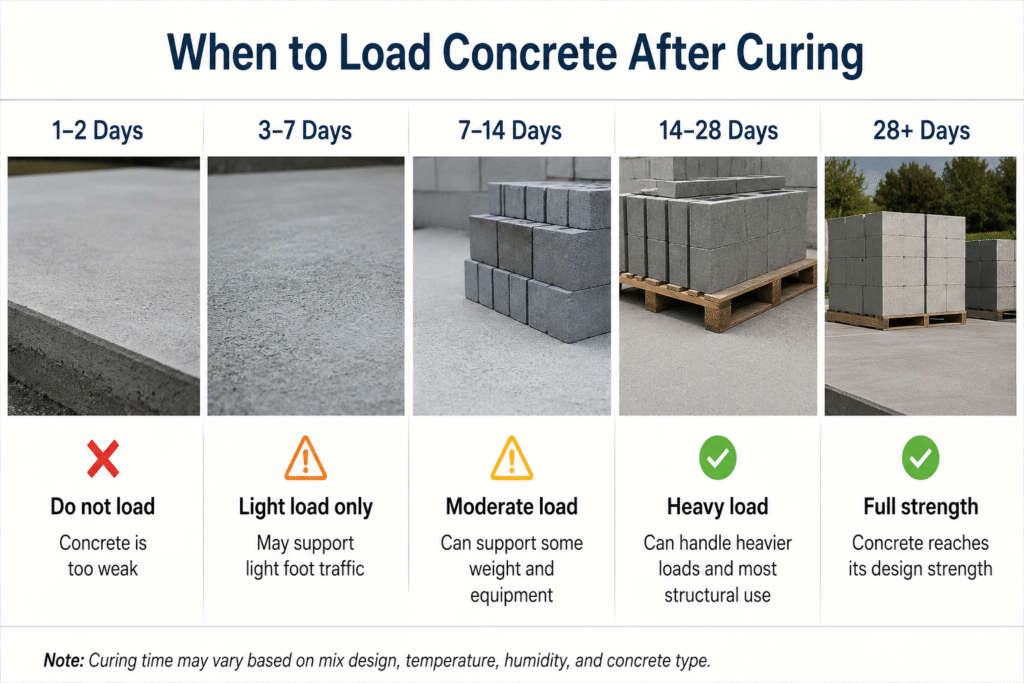
I've seen expensive mistakes here. A client once parked a loaded truck on 5-day-old concrete. The wheels sank 2 inches. We had to cut out and replace that section.
Loading Timeline by Weight
| Time After Pour | Safe Loading | Examples |
|---|---|---|
| 24 hours | 50 lbs/sq ft | Walking carefully |
| 48 hours | 100 lbs/sq ft | Normal foot traffic |
| 7 days | 500 lbs/sq ft | Furniture, light equipment |
| 14 days | 1000 lbs/sq ft | Forklifts (empty) |
| 28 days | Design load | Full traffic |
Factors That Change Loading Time
Temperature: Cold weather doubles these times. Hot weather might reduce by 20%.
Concrete strength: High-early mixes handle loads faster. Regular mixes need full time.
Load type: Static loads (sitting still) cause less damage than moving loads.
Support conditions: Slabs on grade handle loads sooner than suspended slabs.
Testing Before Loading
For critical loads, I test actual strength:
- Schmidt hammer: Quick field test
- Core samples: Lab testing for accuracy
- Maturity meters: Continuous monitoring
Special Considerations
Construction loads often exceed design loads. Concrete trucks, cranes, and material deliveries weigh more than normal traffic. Plan routes to avoid new concrete.
Point loads concentrate weight. Use plywood or steel plates to spread heavy equipment weight.
Early loading sometimes can't wait. Use accelerators in the mix and keep concrete warm. But expect to pay more for materials and possibly repairs later.
Conclusion
Concrete curing takes 28 days for full strength, but you can use it carefully much sooner with proper planning and patience.
-
"Concrete - Wikipedia", https://en.wikipedia.org/wiki/Concrete. Standard references indicate that concrete typically reaches about 70% of its design strength at 7 days and full strength at 28 days, though actual values depend on mix and conditions. Evidence role: statistic; source type: encyclopedia. Supports: Concrete needs 24-48 hours for initial set, 7 days to reach 70% strength, and 28 days for full design strength.. Scope note: Values may vary with mix design and environmental factors. ↩
-
"Table 1 Setting Time of Concrete at Various Temperature", https://www.engr.psu.edu/ce/courses/ce584/concrete/library/materials/Admixture/Link-settime.htm. Technical literature confirms that temperature, mix design, and curing methods significantly affect concrete curing rates and final strength. Evidence role: mechanism; source type: education. Supports: Temperature, mix design, and curing methods change these times.. Scope note: Specific impacts depend on local conditions and materials used. ↩
-
"Water–cement ratio - Wikipedia", https://en.wikipedia.org/wiki/Water%E2%80%93cement_ratio. Research and engineering texts show that lower water-cement ratios produce stronger but slower-curing concrete, while higher ratios accelerate curing but reduce strength. Evidence role: mechanism; source type: research. Supports: Lower ratios mean stronger concrete but slower curing. Higher ratios cure faster but create weaker concrete.. Scope note: Exact effects depend on mix and environmental conditions. ↩
-
"The 28-Day Myth of Concrete Curing", https://precast.org/blog/28-day-myth/. Construction standards indicate that typical 4-inch slabs require 24-48 hours for light foot traffic, 7 days for normal use, and 28 days for full strength, though site conditions may alter these times. Evidence role: statistic; source type: government. Supports: A 4-inch concrete slab needs 24-48 hours before light foot traffic, 7 days before normal use, and 28 days to reach full strength.. Scope note: Recommendations may vary with slab design and environmental factors. ↩
-
"Concrete: The Basic Mix", https://matse1.matse.illinois.edu/Concrete/bm.html. Educational and engineering sources describe the 4-2-1 mix as 4 parts gravel, 2 parts sand, 1 part cement by volume, commonly used for mass concrete where high strength is not required. Evidence role: definition; source type: education. Supports: The 4-2-1 rule uses 4 parts gravel, 2 parts sand, 1 part cement by volume. This lean mix works for mass concrete like foundations where high strength isn't critical but volume matters.. Scope note: Suitability depends on structural requirements and local codes. ↩
-
"Cold weather concrete pours – a word of advice from an expert", https://www.iowadnr.gov/news-release/2023-12-12/cold-weather-concrete-pours-word-advice-expert. Construction standards recommend waiting at least 7 days before applying significant loads, 28 days for full design loads, and 24-48 hours for light foot traffic, though actual times depend on mix and site conditions. Evidence role: statistic; source type: government. Supports: Concrete needs 7 days minimum before any significant load, 28 days for full design loads. Light foot traffic works after 24-48 hours. Heavy equipment and vehicles need 28+ days depending on concrete strength and load weight.. Scope note: Recommendations may vary with concrete strength and environmental factors. ↩