Your concrete mix is weak or cracking. The wrong water-cement ratio is ruining your project's integrity and budget. You need to master this critical balance for success.
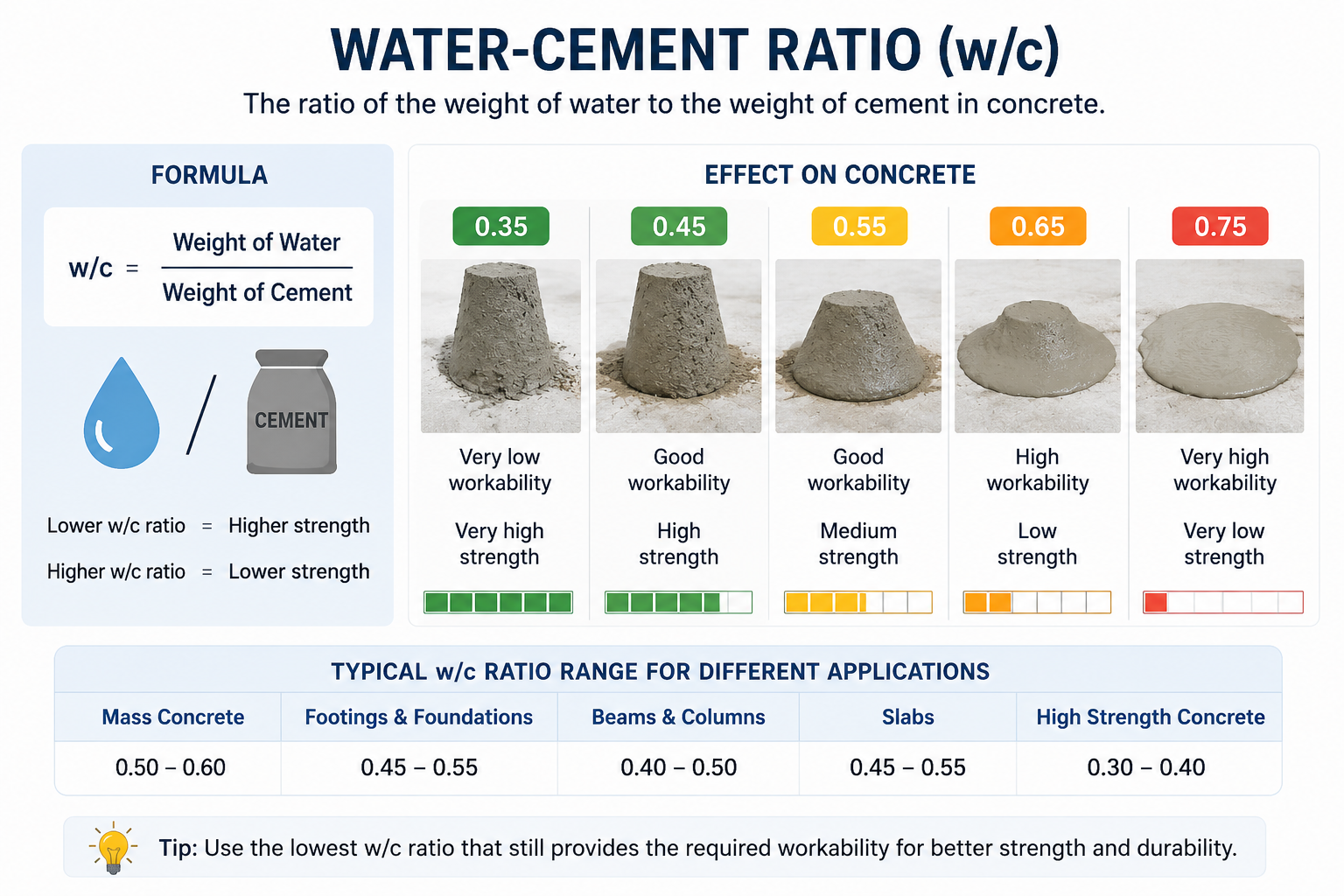
The ideal water-cement (w/c) ratio is typically between 0.40 and 0.50 by weight for most projects. Lower ratios provide stronger, more durable concrete, while higher ratios improve workability but reduce strength. The precise need varies by application.
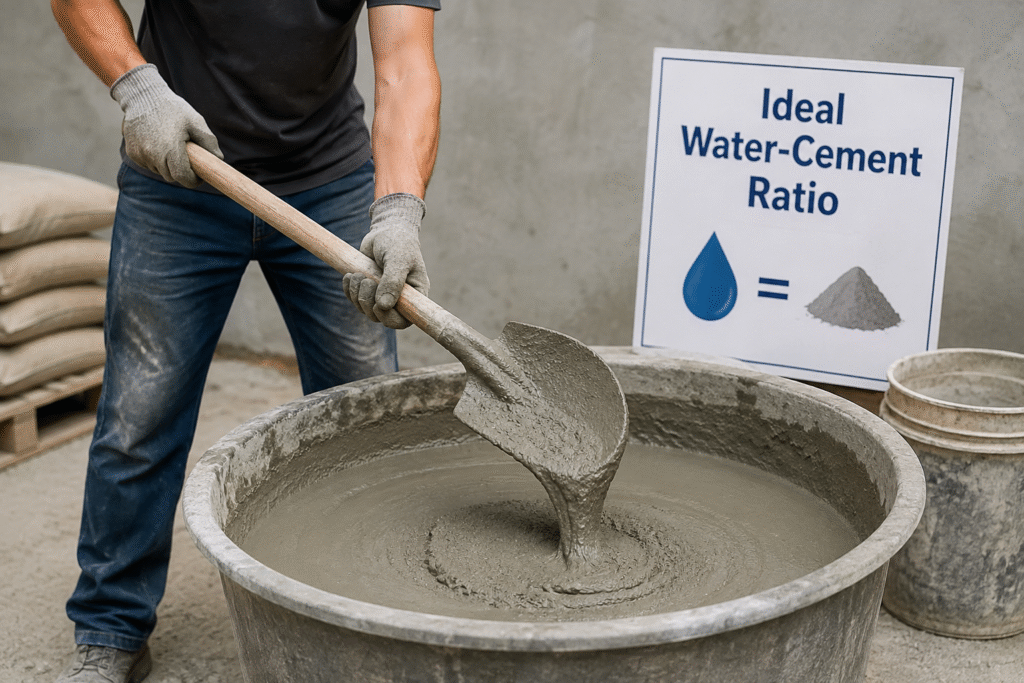
I've been in this business for years, and I've seen how a simple detail—the amount of water in a concrete mix—can make or break a multi-million dollar project. A client in Saudi Arabia, Mark, once called me in a panic. His team was getting inconsistent results, and the project was falling behind schedule. The problem wasn't the quality of his cement or aggregates; it was the water. Getting the water-cement ratio right is the foundation of quality construction. Let me walk you through how to get it right every single time.
How Do You Determine Recommended Ratios by Project Type?
Using one mix for all jobs? This approach often leads to failed inspections and expensive rework. You must tailor your water-cement ratio to each specific project for success.
For general slabs, I recommend a 0.45-0.55 w/c ratio. For high-strength structures (C50+), it must be ≤0.35. For specialized projects like nuclear plants, the ratio can be as low as 0.28, according to ACI 211.1 standards.1
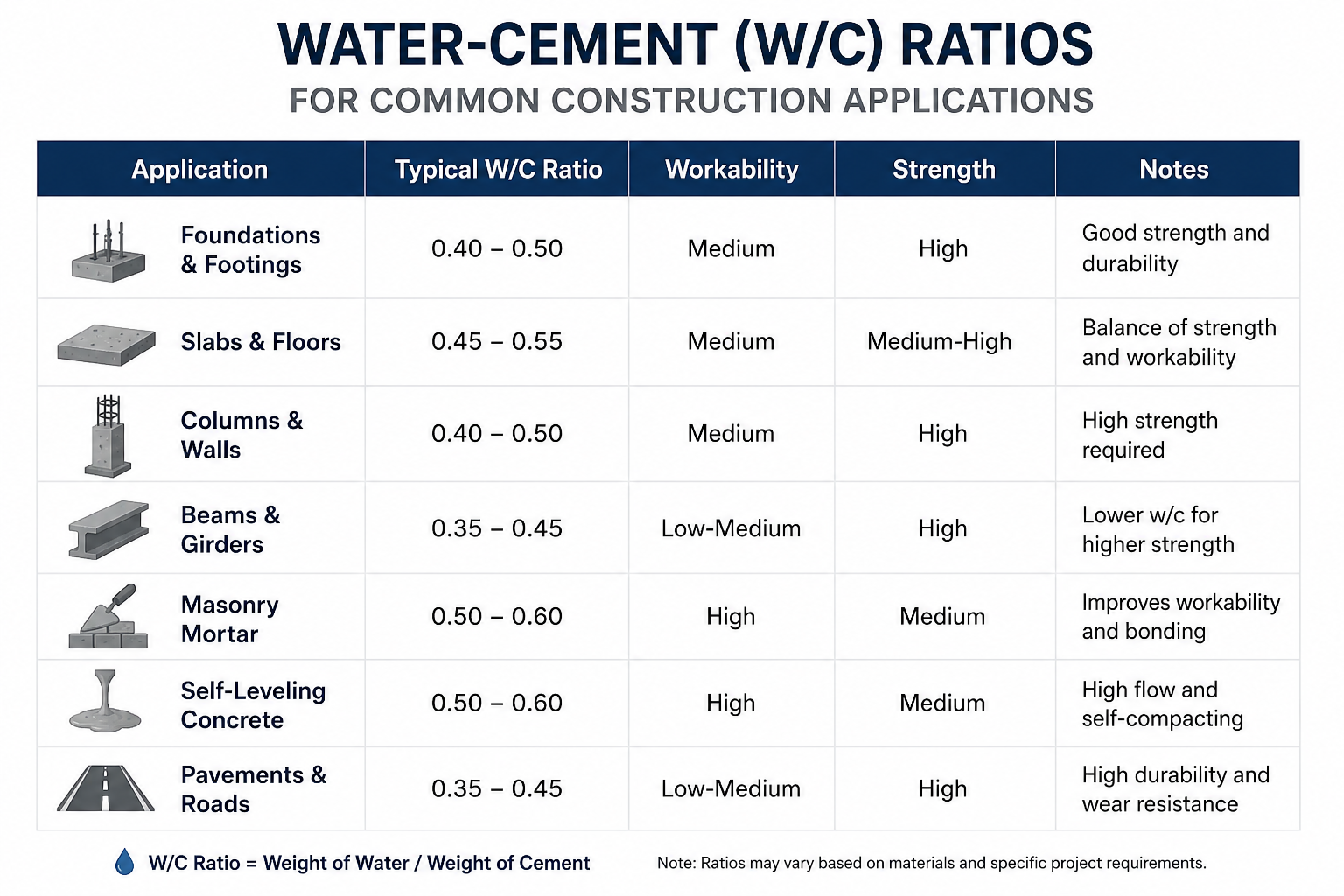
Getting the ratio right depends entirely on what you are building. It's a balance between strength, durability, and how easily you need to pour the concrete. I remember working with a customer in Brazil building high-rise towers. They needed high early strength to speed up their construction cycle. We dialed in a lower w/c ratio combined with a specific grade of our Kehao Hydroxypropyl Methylcellulose (HPMC) to achieve it. Different projects have different demands.
General Structures (Slabs, Pavements)
For things like residential floors or local roads, you prioritize workability so your team can place and finish the concrete easily. A slightly higher water content is acceptable here. But be careful not to go too high, or you'll get cracks.
High-Strength Applications (High-rises, Bridges)
For structures that bear heavy loads, strength is everything. A lower water-cement ratio is non-negotiable. This creates a dense, less porous concrete that can withstand immense pressure. For these, you must use a superplasticizer to maintain workability.
Specialized Engineering (Nuclear, Marine)
These are extreme cases. Projects like the Hangzhou Bay Bridge in China use very low ratios (around 0.33) plus additives like silica fume to fight chloride from the seawater. It’s all about creating an impenetrable barrier.
| Project Type | Recommended W/C Ratio | Key Priority |
|---|---|---|
| Residential Slabs | 0.45 - 0.55 | Workability & Cost |
| High-Rise Buildings | 0.35 - 0.40 | Compressive Strength |
| Bridges (Exposed) | 0.33 - 0.40 | Durability & Low Permeability |
| Nuclear Plants | ≤ 0.28 - 0.32 | Maximum Density & Impermeability |
Why Does the Water-Cement Ratio Matter So Much?
You see workability, not long-term durability. But excess water creates voids in the concrete, inviting corrosion and early failure. Understanding this ratio is key to your project's lifespan.
The w/c ratio is the single most important factor for concrete quality. It directly determines the final strength, permeability, and durability. A lower ratio means denser, stronger concrete, while a higher ratio creates a weaker, porous structure prone to damage.
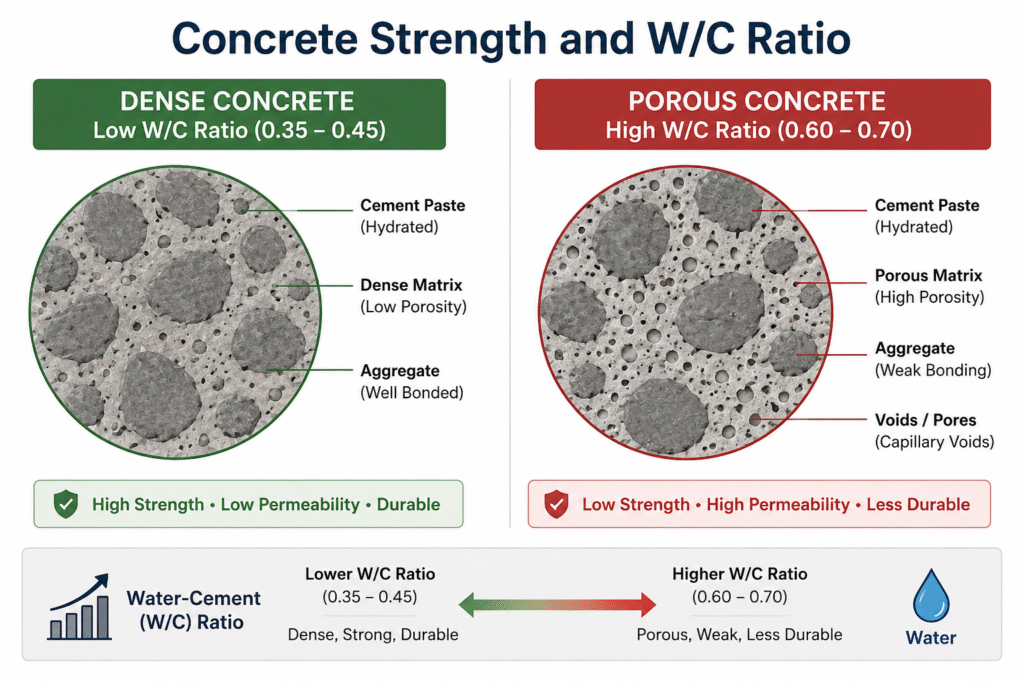
Think of it this way: cement needs a specific amount of water for the chemical reaction (hydration) that gives it strength. Any water beyond that amount is just "water of convenience" to make the mix flow. This extra water eventually evaporates, leaving behind tiny tunnels and pores. These pores are a highway for water, salts, and chemicals to enter and attack the concrete and the steel rebar inside. I always tell my clients, like Mark in Saudi Arabia, that controlling the water is cheap insurance against future repairs.
Impact on Strength
The fundamental rule is simple: less water equals more strength. The pores left by excess water weaken the internal structure. For high-strength concrete (like C50+), you must keep the w/c ratio below 0.35.
The Durability Trap
Here’s a mistake I see often. A team achieves the required compressive strength but used a high w/c ratio (maybe >0.40) to make pouring easier. They pass the initial strength test. But in an exposed environment like a bridge or coastal structure, that porous concrete will fail prematurely. Chlorides will penetrate and corrode the rebar within years. The Hangzhou Bay Bridge project avoided this trap by using a low 0.33 ratio with 8% silica fume, which drastically reduced chloride attack.
Impact on Workability
Of course, you can't pour a mix that is too stiff. This is where modern admixtures, like our Kehao superplasticizers and cellulose ethers (HPMC), become critical. They allow you to maintain excellent workability even with very low water-cement ratios, solving the trade-off between strength and ease of use.
What Is the Typical Water-Cement Ratio for General Construction?
You need a go-to number for everyday jobs. Guessing on-site can lead to mixes that are too wet or too stiff, wasting time and materials. Here's a reliable baseline ratio.
For general construction like residential slabs, sidewalks, and small foundations, a water-cement ratio between 0.45 and 0.55 is standard.2 This range offers a good balance between workable consistency and sufficient strength for common applications.
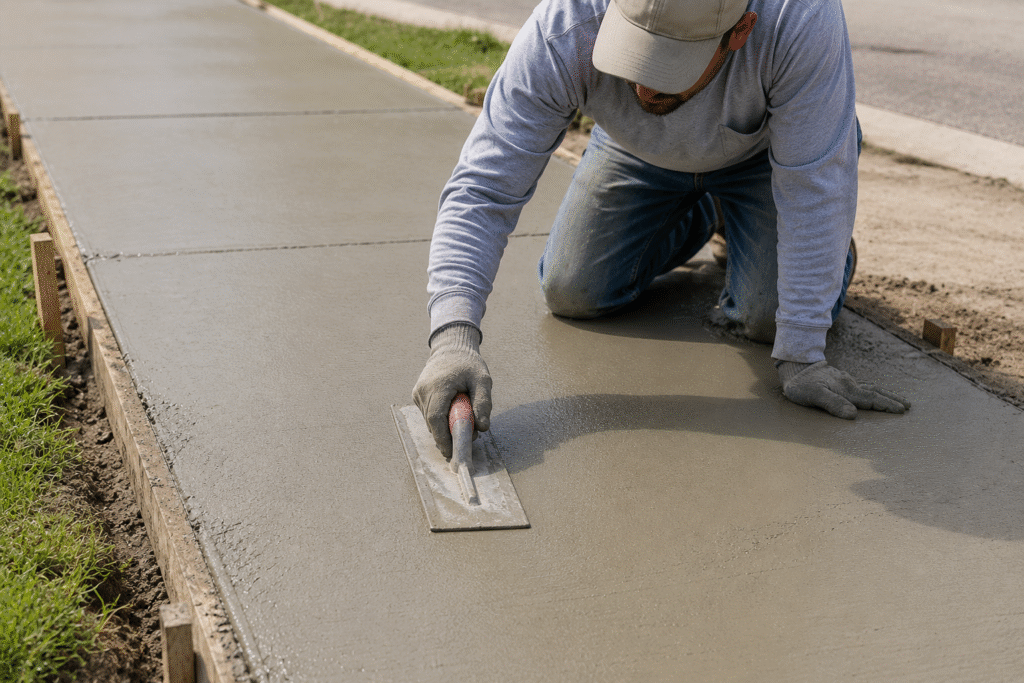
This 0.45 to 0.55 range is the sweet spot for many projects. I had a client in Pakistan who was building a large housing development. His crews were adding too much water on-site because the weather was hot and the mix was setting too fast. The result was widespread cracking in the foundations. We solved it not by adding more water, but by incorporating our Kehao HPMC into his mix. This improved water retention, giving his team more time to work the concrete without sacrificing the crucial w/c ratio.
The Sweet Spot: 0.45-0.55
In this range, the concrete is typically strong enough for foot traffic, residential loads, and non-structural elements. It's also fluid enough to be placed and finished without extraordinary effort or requiring expensive admixtures, making it cost-effective.
What happens with too much water?
Going above 0.55 dramatically increases permeability and reduces strength.3 As the excess water evaporates, it leaves a network of capillary pores. The concrete becomes like a sponge, absorbing moisture, which leads to freeze-thaw damage in cold climates and rebar corrosion in all climates. It will also be prone to excessive shrinkage and cracking.
What happens with too little water?
Going below 0.40 without a water-reducing admixture creates a very stiff, dry mix. It will be difficult to place, compact, and finish. You will likely end up with voids and honeycombing because the concrete couldn't flow into all the corners of the formwork, resulting in a weak, flawed structure.
Which Is Stronger, a 1:2:4 or 1:3:3 Concrete Mixture?
You're looking at concrete mix designs and are confused by the numbers. Choosing the wrong one means wasting materials or pouring a weak slab. Let's break down these classic ratios.
Generally, a 1:2:4 mix (cement:sand:aggregate) is stronger than a 1:3:3 mix. The 1:2:4 ratio has proportionally more cement relative to the fine aggregate (sand), leading to a richer paste and better binding, which typically results in higher compressive strength.
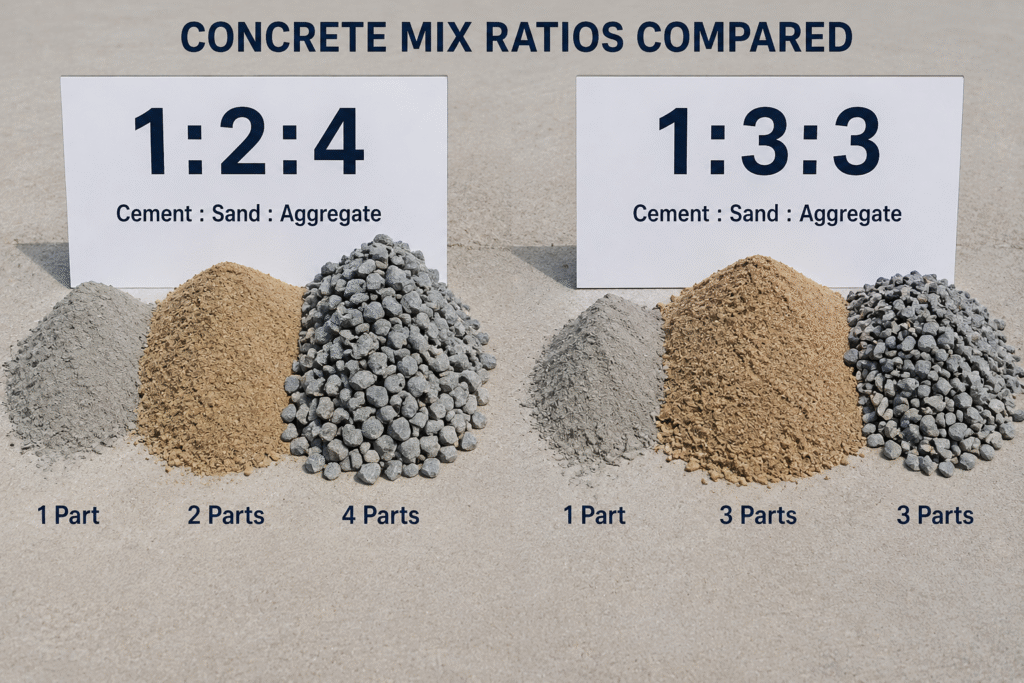
These volumetric ratios are a classic way of describing a mix, but they are less precise than modern weight-based designs. Think of them as recipes. The key is in the ingredients and their proportions. I always advise large-scale clients to move towards batching by weight for true quality control, but understanding these volume mixes is still useful on many job sites.
Understanding Volumetric Ratios
The numbers (e.g., 1:2:4) represent the ratio of ingredients by volume, not weight.
- First Number: Cement
- Second Number: Fine Aggregate (Sand)
- Third Number: Coarse Aggregate (Gravel/Stone)
Comparing 1:2:4 vs. 1:3:3
The 1:2:4 mix is considered a standard nominal mix. The 1:3:3 mix has more sand and less coarse aggregate. While the total aggregate is the same (6 parts), the composition is different. The higher sand content in the 1:3:3 mix demands more water and cement paste to coat all the particles, which can make it weaker if the cement content isn't increased. The 1:2:4 mix generally has a better particle size distribution for creating a dense, strong concrete.
| Feature | 1:2:4 Mix | 1:3:3 Mix |
|---|---|---|
| Composition | 1 Cement: 2 Sand: 4 Gravel | 1 Cement: 3 Sand: 3 Gravel |
| Aggregate Type | Gravel-heavy | Sand-heavy |
| Typical Strength | Stronger | Weaker |
| Use Case | Structural Elements (Beams, Columns) | General Work (Mass concrete, fill) |
The Role of Water Remains Key
This is critical: for either the 1:2:4 or 1:3:3 mix, the actual strength you achieve will ultimately be determined by the amount of water you add—the water-cement ratio. Adding too much water will make a 1:2:4 mix weaker than a properly hydrated 1:3:3 mix.
What is the 4-2-1 Rule for Concrete?
You heard about a "4-2-1 rule" for concrete. It sounds simple, but you wonder if it is reliable for professional work. Let's explain what this rule means and where it falls short.
The 4-2-1 rule is a simplified recipe for concrete by volume: 4 parts aggregate (gravel), 2 parts sand, and 1 part cement. It's a rough guideline for small, non-structural projects like garden paths, not for professional construction.
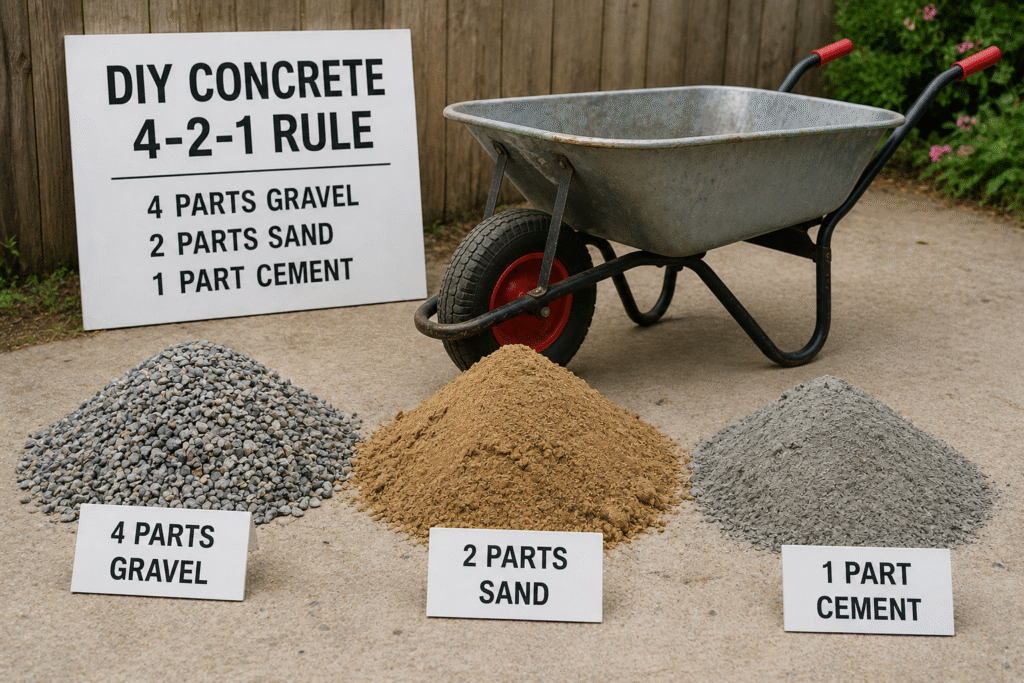
I sometimes hear this rule mentioned by smaller contractors or DIY enthusiasts. It's an easy-to-remember recipe that provides a basic concrete mix. However, I would never recommend it for any project where structural integrity is a concern. For my professional clients like Mark, using such a rule would be a direct violation of quality control standards. Professional work demands precision that this rule simply cannot provide.
A Rule of Thumb for DIY
For setting a fence post, making a small garden paver, or a non-load-bearing pad for an air conditioning unit, the 4-2-1 rule can be "good enough." It's based on readily available materials and simple shovel-based measurements. The result will be concrete, but its strength and durability will be completely unknown and inconsistent.
Why Professionals Don't Use It
There are several major flaws with this rule for professional applications:
- Volume vs. Weight: Measuring by volume (e.g., shovels) is highly inaccurate. The moisture content in sand can bulk it up, so a "shovel" today is not the same as a "shovel" tomorrow. Professionals use weight for batching, which is exact.
- Aggregate Grading: It doesn't account for the size and shape of the aggregates, which is critical for creating a dense, strong mix with minimal voids.
- No Quality Control: It offers no way to guarantee a specific strength (e.g., C30 or 4000 psi).
The Missing Ingredient: Water
The biggest flaw of the 4-2-1 rule is that it gives no guidance on the most important ingredient of all: water! As we've discussed, the water-cement ratio controls everything. Without a specified water amount, the 4-2-1 rule is just a recipe for unpredictable results.
What Is the 20/30/40 Rule in Concrete?
You keep hearing different "rules" for concrete. It can be hard to know which ones are real industry standards and which are just talk. Let's decode the 20/30/40 rule.
The 20/30/40 rule is not a concrete mix ratio. It often refers to concrete curing principles: concrete reaches about 20% strength in 1 day, 30% in 3 days, and 40-50% in 7 days, with full design strength typically measured at 28 days.
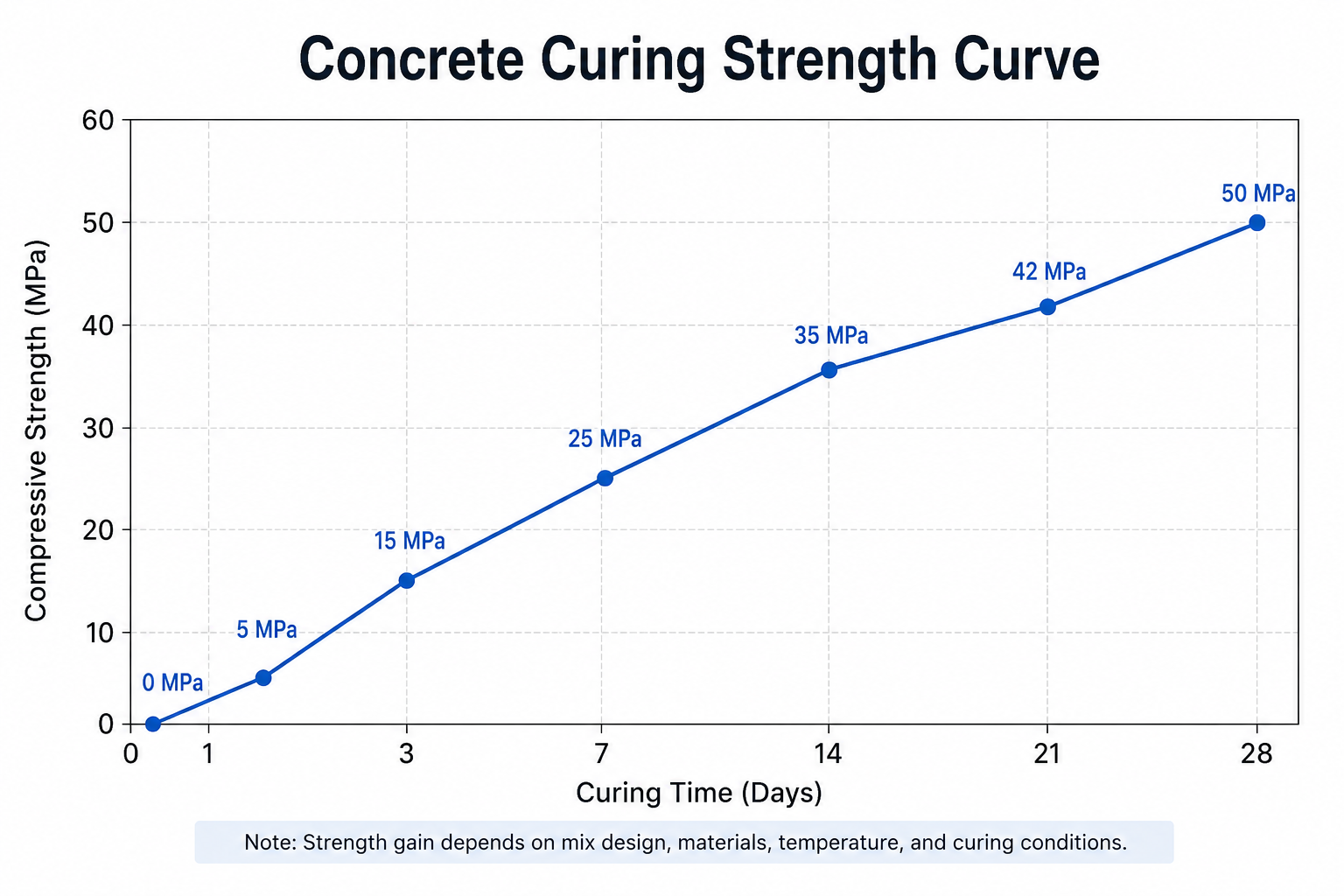
This is a common point of confusion. A client once asked me to supply materials for his "20/30/40 concrete," and I had to gently explain that he was thinking about the curing process, not the recipe itself. Understanding this strength gain curve is incredibly important for project scheduling, like knowing when you can safely remove formwork or put a structure into service.
Not a Mix Ratio, but a Curing Guideline
Again, this is not a recipe like 1:2:4. It's a rough approximation of how fast concrete gets strong. The cement hydration process is not instant; it's a chemical reaction that continues for weeks and even months, as long as water and unhydrated cement are present.4 The numbers are a general guide and can change based on temperature, humidity, and the mix design itself.
The Science of Strength Gain
Here's a typical, simplified timeline for standard concrete at room temperature:
- 1-2 Days: Initial set. Strong enough to walk on carefully. (~20% strength)
- 7 Days: Significant strength gain. Formwork for walls can often be removed. (~40-65% strength)
- 28 Days: This is the industry-standard age for testing concrete to confirm it has reached its full design strength (e.g., C30 or 4000 psi). (~99% of design strength)
How Additives Influence Curing
This is where it gets interesting for professionals. We don't have to be passive observers of this timeline. With the right additives, we can control it. For instance, using accelerating admixtures can achieve higher early strength, which is great for cold weather concreting. Conversely, in hot climates like the UAE or Iran, retarders are used to slow down the initial set, giving crews more time. My Kehao HPMC plays a vital role here by retaining water, ensuring the hydration process can continue efficiently, leading to better overall strength development and reduced surface cracking.
What Are Some Frequently Asked Questions About Concrete Ratios?
You still have some lingering questions. Small doubts can lead to big mistakes on the job site. Let's answer some of the most common questions I get asked by my customers.
Common questions involve adjusting for hot weather (use less initial water, add ice), the role of admixtures (they modify properties like workability), and how to test consistency (the slump test). These are key for on-site quality control.
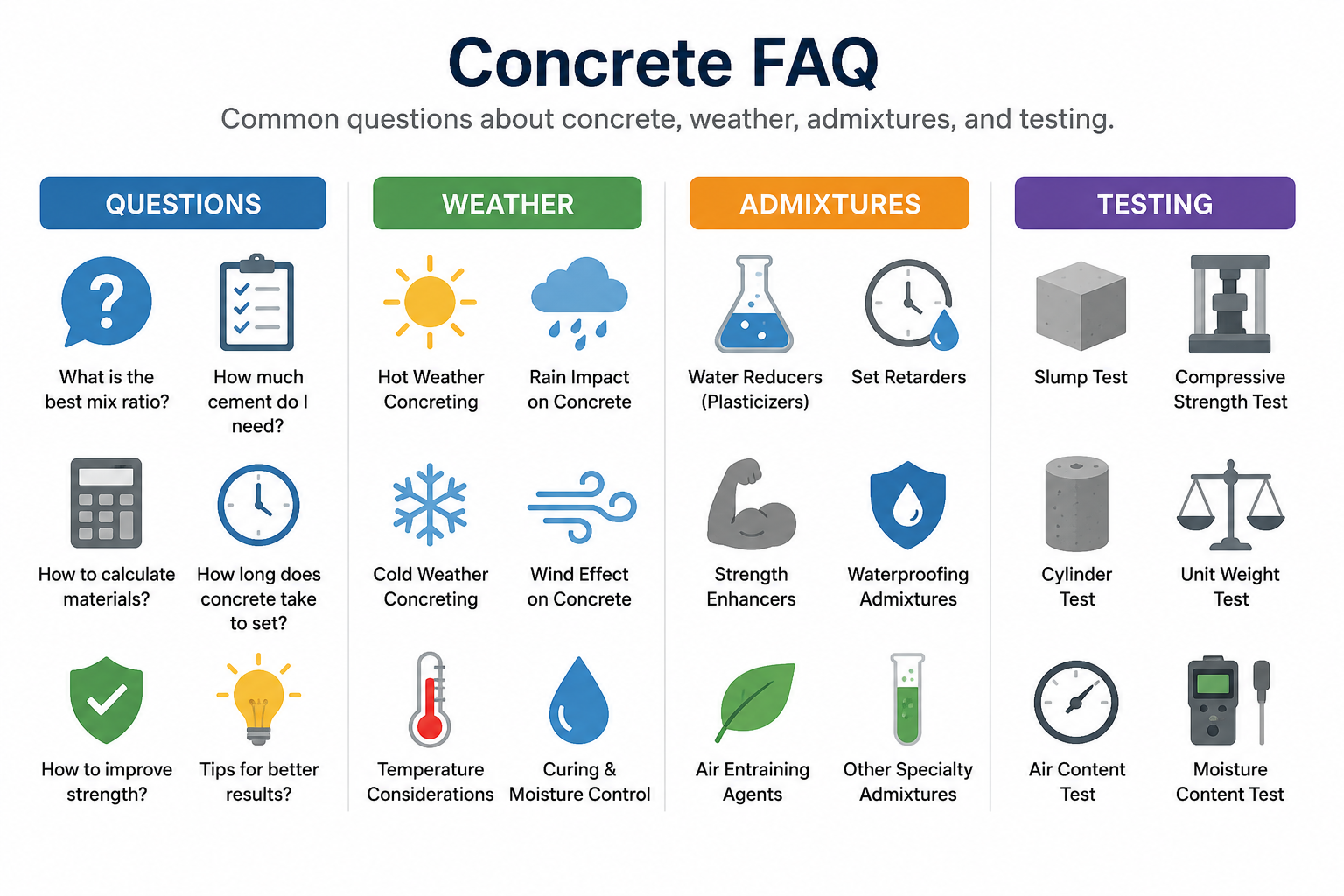
Every project has unique challenges. A mix design that works perfectly in the mild climate of Georgia might be a disaster in the heat of Dubai. A client in Vietnam once struggled with self-compacting concrete blocking his pumps until we adjusted the mix with the right viscosity modifier. Here are answers to the practical questions that come up every day.
How does hot weather affect the w/c ratio?
Hot weather is the enemy of good concrete. Water evaporates quickly from the mix, leading to a loss of workability and a false, rapid set. The temptation is to add more water, but this ruins the w/c ratio. The professional solution is to cool the aggregates, use chilled water or ice as part of the mix water, and incorporate a retarding admixture to slow down hydration.
Can I just add more water on-site if the mix is too stiff?
No. Never. This is called "re-tempering," and it is the most common cause of concrete failure. Adding water on-site completely destroys the carefully designed water-cement ratio. It increases permeability and drastically reduces the final strength. If a mix is too stiff, the only correct solution is to use a water-reducing admixture or reject the batch.
What is a slump test?
The slump test is a simple, effective on-site method to measure the consistency or workability of fresh concrete. It involves filling a cone with concrete, removing the cone, and measuring how much the concrete "slumps" down. A higher slump means a more fluid mix. It's an essential quality control check to ensure consistency from one batch to the next.
Conclusion
Mastering the water-cement ratio is key to strong, durable concrete. Use these principles to ensure every project succeeds, avoiding costly mistakes and building structures that will last for generations.
-
"Basic Relationship - Concrete Mix Design - Union College", https://concrete.union.edu/basic.htm. ACI 211.1 and related technical documents discuss the use of very low water-cement ratios (as low as 0.28) for specialized, high-durability concrete applications such as nuclear facilities. Evidence role: case_reference; source type: institution. Supports: For specialized projects like nuclear plants, the ratio can be as low as 0.28, according to ACI 211.1 standards.. Scope note: Specific ratio may depend on project requirements and supplementary materials used. ↩
-
"Water–cement ratio - Wikipedia", https://en.wikipedia.org/wiki/Water%E2%80%93cement_ratio. Construction handbooks and building codes recommend a water-cement ratio in the range of 0.45 to 0.55 for general-purpose concrete used in residential and light commercial applications. Evidence role: statistic; source type: encyclopedia. Supports: For general construction like residential slabs, sidewalks, and small foundations, a water-cement ratio between 0.45 and 0.55 is standard.. Scope note: Local codes and environmental conditions may affect the recommended range. ↩
-
"Water–cement ratio - Wikipedia", https://en.wikipedia.org/wiki/Water%E2%80%93cement_ratio. Research studies and technical standards show that increasing the water-cement ratio above 0.55 leads to higher permeability and lower compressive strength in concrete. Evidence role: mechanism; source type: paper. Supports: Going above 0.55 dramatically increases permeability and reduces strength.. Scope note: The degree of impact may vary with mix design and curing conditions. ↩
-
"Calcium silicate hydrate - Wikipedia", https://en.wikipedia.org/wiki/Calcium_silicate_hydrate. Materials science textbooks describe cement hydration as a prolonged chemical reaction that can continue for months if water and unhydrated cement remain available. Evidence role: mechanism; source type: education. Supports: The cement hydration process is not instant; it's a chemical reaction that continues for weeks and even months, as long as water and unhydrated cement are present.. Scope note: The rate of reaction slows significantly after the first month. ↩